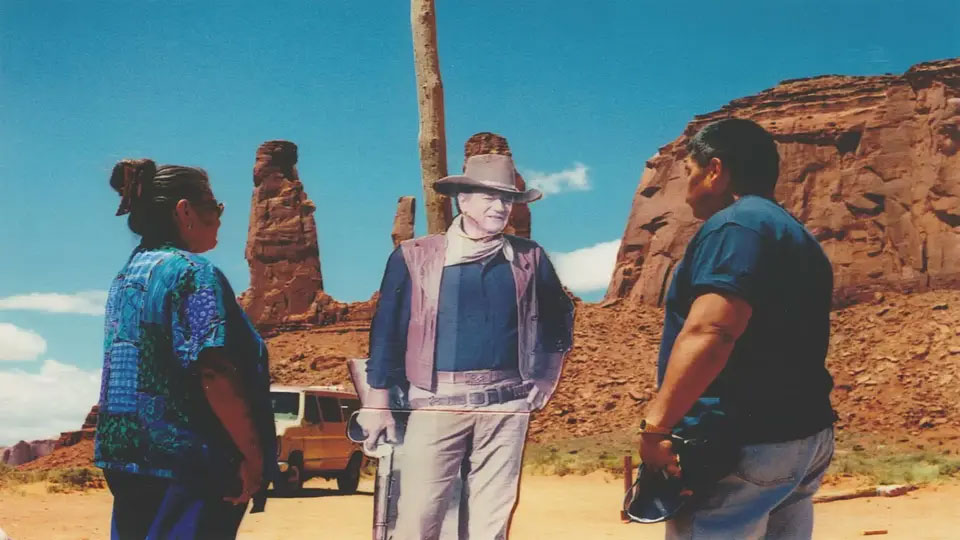


On Sunday, Sept. 21, NAU’s McAllister program in Community, Culture, and the Environment (CC&E) will host a screening of the acclaimed documentary “The Return of Navajo Boy,” along with two panel discussions connecting the film’s themes to environmental and health challenges that face Indigenous communities in the Southwest today.
“The Return of Navajo Boy,” first released in 2000, follows the Cly family of Monument Valley as they reunite to place 1950s Navajo Nation film footage back into the hands of the Diné and raise awareness of the dire toll that 20th-century uranium mining has taken on the local people and lands. After its release, the film didn’t just win international acclaim—it also triggered a federal investigation into uranium contamination in the Four Corners region, leading to some monetary reparations for those who had contracted lung cancer, kidney disease and other health complications.
Regents’ Professor Bruce Hungate, chair of CC&E, said with mining operations resuming this year in parts of northern Arizona, the documentary is more relevant than ever.
“This is not just history,” he said. “With uranium mining and hauling happening again today, these risks are current. This film grounds today’s conversations about environmental justice and Indigenous health the same way it did 25 years ago.”
Tommy Rock, an assistant research professor at NAU, said he and Hungate dreamt up the screening after they spoke on a panel about the film at Chicago’s Newberry Library.
“A lot of the conversation was about uranium contamination—people were asking, ‘What’s up with that? What’s going on?’” Rock said. “Bruce and I thought if we had this discussion at NAU, we could go deeper. We could bring together all the leaders who are studying this and talking about this right now.”
After a noon reception and a 1 p.m. film screening, CC&E will host two discussions. The first, a public-facing legacy panel, will explore the film and its continuing impacts, bringing together Rock, film director Jeff Spitz, John Wayne Cly (the eponymous “Navajo Boy” who returned), film narrator Lorenzo Begay, Corey Begay and Breauna Atine. The second panel, also open to the public, will unite tribal leaders, organizers and researchers for a conversation about science, organizing and action related to the modern increase in uranium hauling in the region.
Rock said CC&E scheduled the event at midday to ensure members of the Navajo, Hopi, Havasupai, White Mesa Ute and other tribal communities can attend and return home safely the same day. The event will provide a unique chance for them to connect with students, scholars and Flagstaff community members who care about Indigenous health and environmental safety.
“With tribal leaders, students and researchers coming to this event, we have a real opportunity to bridge divides and build community around this issue and make change,” Rock said. “We have the strength, we have the numbers. This is what democracy is all about: coming together, making changes and improving quality of life.”
Agenda
1 p.m.
Screening of “The Return of Navajo Boy”
Cline Library Assembly Hall (Room 102)
2:10-3:15 p.m.
Legacy panel discussion
Panelists: Tommy Rock, Jeff Spitz, John Wayne Cly, Lorenzo Begay, Corey Begay and Breauna Atine
Cline Library Assembly Hall (Room 102)
3:30-5:30 p.m.
Uranium Science and Community Health Expert Forum
Panelists: Karletta Chief, Chris Shuey, Carletta Tilousi, Carrie Nuva Joseph, Petuuche Gilbert, Wynona Baheshone, Tommy Rock, Jani Ingram and others
Cline Library Assembly Hall (Room 102)
Information for the media
Please RSVP to one or both panel discussions by emailing jill.kimball@nau.edu. A backgrounder, confirmed names and titles for panelists, approved stills and contact lists for follow-up can be provided on request.
To organize brief onsite interviews with Tommy Rock and/or Jeff Spitz on the day of the event, please email jill.kimball@nau.edu.
Jill Kimball | NAU Communications
(928) 523-2282 | jill.kimball@nau.edu