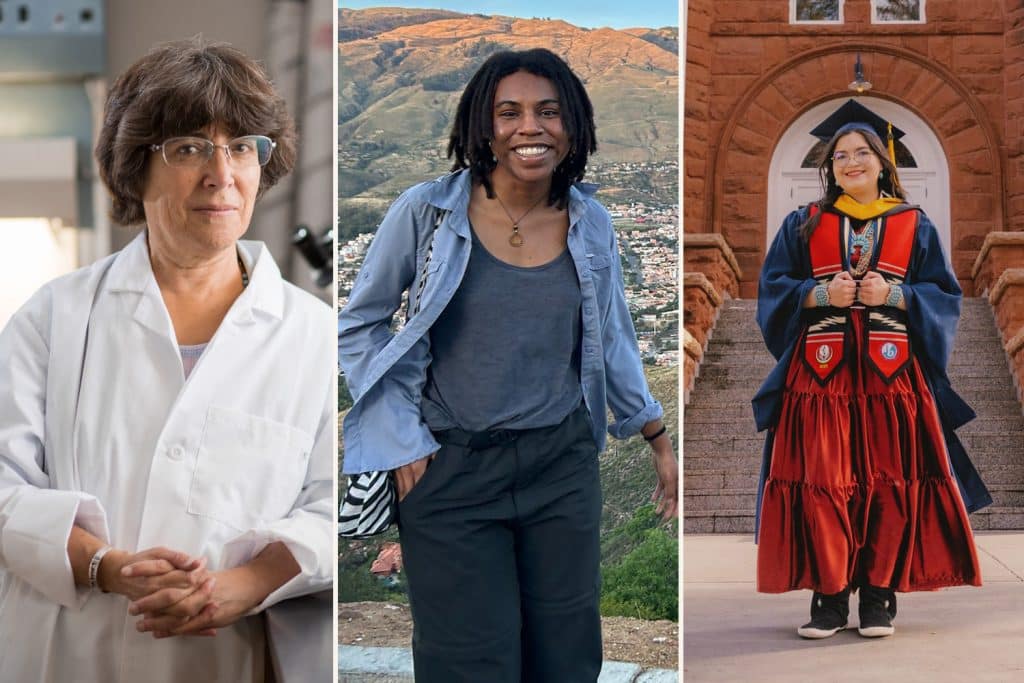


After receiving prestigious 2025 Fulbright Awards, four Lumberjacks—two recent graduates, one faculty member and one staff member—will head to four different continents to make a positive impact on children’s lives, advance conservation work, learn about French higher education administration and integrate Indigenous knowledge into environmental research and practices. They were among the talented 2,100 to win Fulbright Awards from a pool of 11,500 applicants.
In September, biological sciences professor Catherine Propper will travel to Brisbane, Australia, on a Fulbright Specialist Award, where she’ll train researchers on the U.S. Environmental Protection Agency’s ecotoxicology tools and work with international colleagues to open more avenues for Indigenous knowledge to inform ecological, agricultural and nutritional research. In October, Elena Selezneva, who directs interdisciplinary programs at the Center for International Education, will travel to France to familiarize herself with France’s higher education and research system on an International Education Administrators Award. In January, Kaylin McLiverty, who recently earned bachelor’s and master’s degrees from NAU, will head to South Korea with support from a Fulbright English Teaching Assistant Award to promote cross-cultural exchange. And two months later, recent environmental science master’s graduate Elizabeth Randolph will travel to Valdivia, Chile, on an Open Study award to bridge gaps in research on an endangered native tree.
Learn more about the awardees, their destinations and their exciting teaching and research projects below.
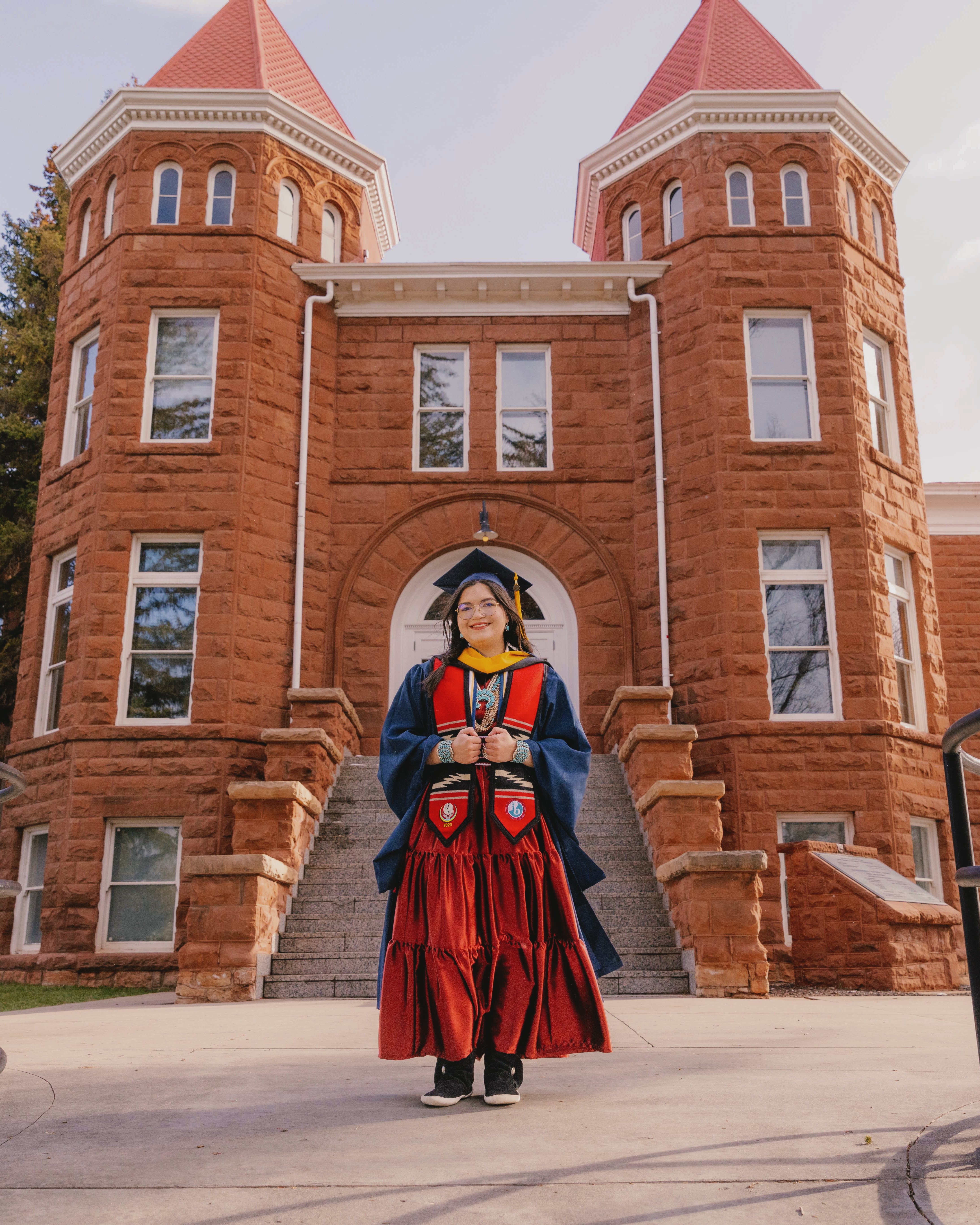
Fostering cultural connection
South Korea may be 6,000 miles away from the Navajo Nation, but distance did not stop Korean pop culture from weaving into the lives of Diné youth.
In the 2010s, “I noticed that on the Navajo reservation, Korean pop culture was gaining significant interest, especially among young Navajos who follow K-pop and K-dramas,” said McLiverty, who is Diné and grew up in Farmington, New Mexico. “This connection resonates with me, as both Navajo and Korean cultures value respect for elders, strong family bonds and a collectivist mindset.”
McLiverty, who is biracial, has always found ways to make connections between cultures and weave cultural understanding into every aspect of life, so it was no surprise that she gravitated toward South Korean media, which provides a glimpse into the country’s distinct traditions and cultural beliefs. Growing up, she learned about Korean culture through manhwa—Korean comics—and videos about Korean food. While McLiverty studied statistics and built a rich fiber arts community at NAU, she set aside time to learn the Korean language and draw more connections between Diné and Korean cultures.
In 2026, McLiverty will continue promoting cross-cultural exchange by traveling to the country to teach English. After six weeks spent in intensive language classes and other orientation programs, she’ll start teaching in a yet-to-be-determined location.
The NAU grad is confident her experiences on the Flagstaff mountain campus have set her up for teaching success. As an undergraduate, McLiverty was a peer mentor with the Office of Indigenous Student Success and the Honors Native American Summer Research Program, where she learned how to cultivate belonging through the development of culturally relevant events and discussions for Indigenous students. And as a graduate student instructor in the Department of Mathematics and Statistics, she learned the fundamentals of lesson planning and classroom management.
Once her year in South Korea is up, McLiverty hopes to teach at a community college near her hometown, inspiring the Navajo Nation’s next generation to explore other cultures and expand their worldview.
“Teaching in my hometown will allow me to continue my journey of learning Navajo from my relatives and encourage my students to connect with global cultures and languages so they can weave their own cultural connections too,” McLiverty said. “I want to cultivate a classroom where cultural exchange is welcomed and encouraged.”
 Saving an endangered tree
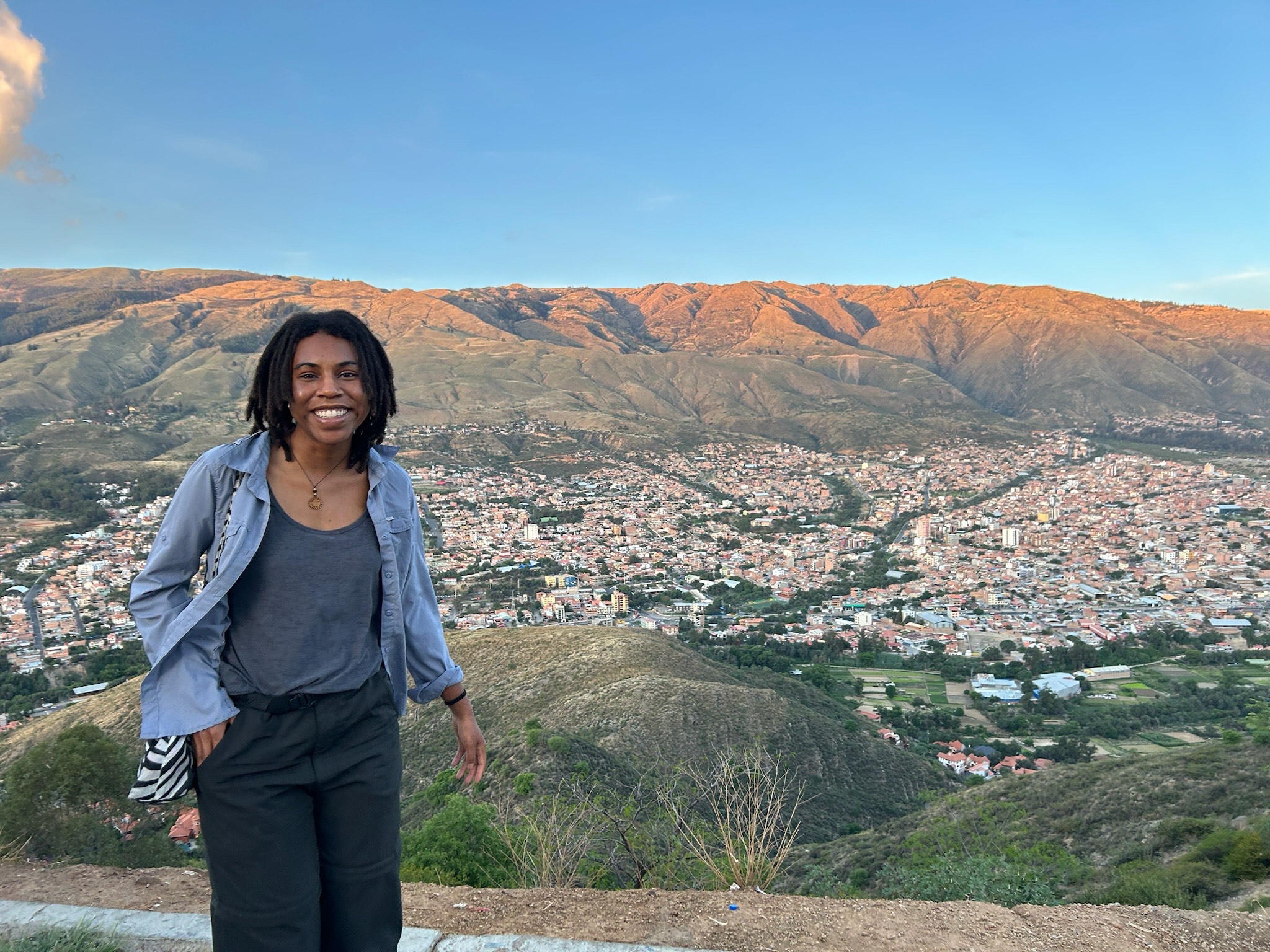
Randolph has long dreamed of a career spent collaborating with conservation experts across the globe. In March, the aspiring environmental journalist will do exactly that thanks to an eight-month Open Study Fulbright in Valdivia, Chile.
As a graduate student in NAU’s School of Earth and Sustainability (SES), Randolph explored the root microbiome of the endangered Alerce tree in central Chile’s Alerce Costero National Park. Now, Randolph hopes to weave her research into a journalistic narrative that makes the case for its protection.
“I’m interested in how microscopic life in the soil supports the Alerce’s resiliency and what these hidden networks reveal about the broader ecosystem,” Randolph said. “As both a scientist and storyteller, I seek to capture the full scale of these relationships—from the unseen exchanges beneath the forest floor to the deep cultural and ecological meaning this ancient tree holds for surrounding communities.”
Randolph said she became a Fulbrighter not only thanks to the experience she gained teaching introductory environmental science courses but also due to invaluable mentorship from SES faculty.
“This work could not have been made possible without the guidance of my advisor, Nancy Johnson, and the support of other faculty such as Rebecca Best,” she said.
Advancing science with Indigenous knowledge
As head of the Environmental Endocrinology lab at NAU, Propper is intimately familiar with ECOTOXicology Knowledgebase, an online tool developed by the EPA that helps scholars find chemical toxicity data for aquatic life, terrestrial plants and wildlife. Propper, her students and her colleagues regularly use ECOTOX and other EPA and U.S. Geological Survey tools to research everything from the impact of arsenic on cancer and wound healing to rural rice farmers’ pesticide exposure in Asia.
Propper’s reputation as an ECOTOX superuser is what earned her a ticket to Brisbane, Australia, on a Fulbright Scholar Award.
“I became pretty adept at how to use ECOTOX, providing information for publications with colleagues who are now at the University of Queensland,” Propper said. “They wanted me to come give a presentation on ECOTOX, and Fulbright is making it happen.”
Over three weeks in September, Propper will train her Queensland colleagues to become just as adept at using ECOTOX as she is, helping propel crucial research on how environmental contaminants affect life on Earth. But that’s not all she’ll do.
“We hope to develop an online exchange program between Indigenous students who work on agriculture and nutrition at both universities,” Propper said. “The students will be able to meet online, interact with each other, take Zoom tours around their farms and help inspire each other to integrate all kinds of Indigenous knowledge into their farming practices.”
Propper explained that exploring Indigenous agricultural traditions from both hemispheres could help all farmers, whether Indigenous or not, explore ways to grow food more sustainably, working with their region’s natural setting rather than against it and ditching toxic chemicals when possible.
“I’m looking forward to being an ambassador for all the good work the EPA does in support of environmental health and human health,” Propper said. “And I’m really excited to learn about Indigenous agricultural practices in a completely different part of the world while introducing Australians to Indigenous practices in this part of the world.”
Education under the Eiffel Tower
Selezneva’s Fulbright will take her to Paris and another region in France for two weeks, where she’ll participate in a group seminar designed to familiarize American higher education administrators with France’s higher ed landscape. She’ll attend briefings, visit various French campuses, meet with French government officials, network with other leaders in higher ed, find out how French culture seeps into higher ed and meet with some of her peers in France.
The program is designed to boost cultural exchange between American and French universities, so Selezneva’s visit could increase Lumberjacks’ opportunities to study and work in France.
If you are interested in applying for a Fulbright award, please contact Lillie Gordon at Natl_Scholarships@nau.edu.
Jill Kimball | NAU Communications
(928) 523-2282 | jill.kimball@nau.edu