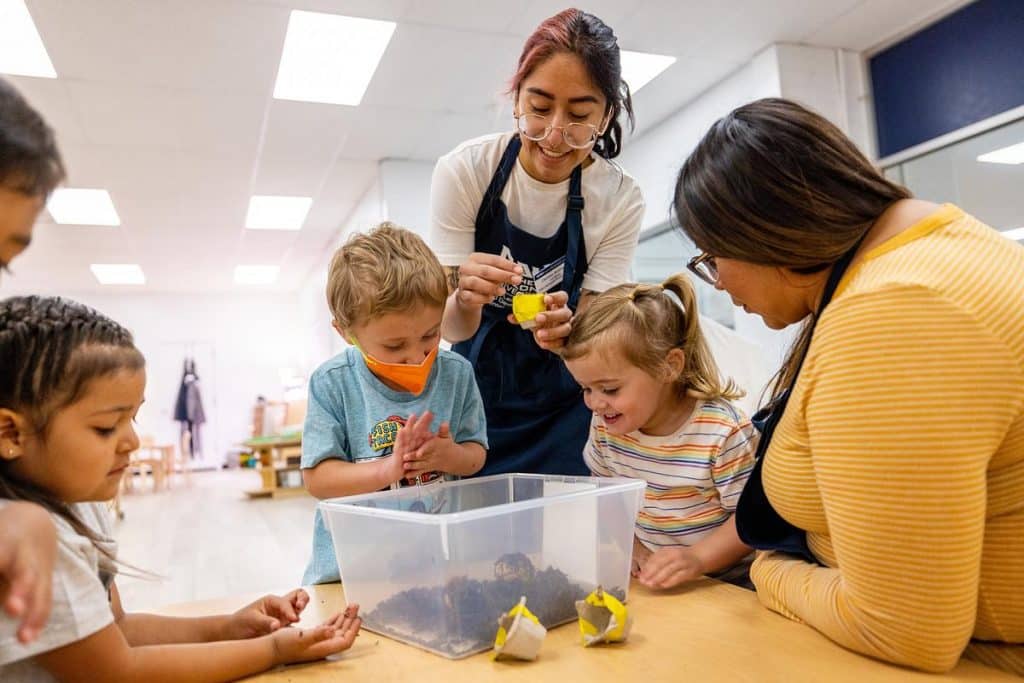


Back in fall 2023, as the weather turned cold, spiders and ants sought refuge inside NAU’s Early Learning and Development Center. The young students, ages 2-5, noticed—and they had some thoughts.
“Some said, ‘Whoa, cool, let me look closer,’ while others went, ‘Gross, get it away, squish it!” said Rebecca Cirzan, director of the center. “All of them had opinions. All of them cared about the bugs in some way.”
Kids learn more when they care—so the ELDC took advantage of this moment. They parlayed a single bug encounter into a three-month student-guided project on creepy crawlies, culminating in one big, beautiful bug presentation.
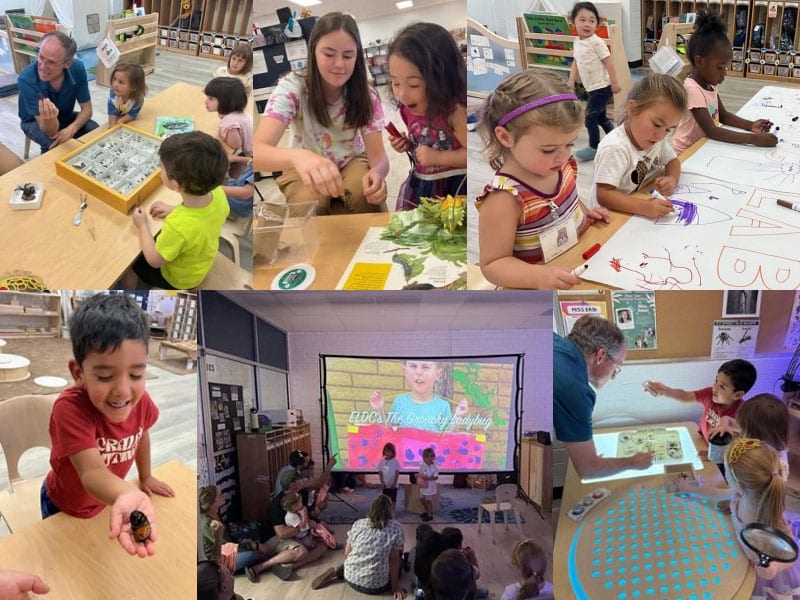
The kids led their own learning journey each step of the way, employing a rare method called inquiry-based learning. They took the helm every step of the way: Developing their own research questions, examining “specimens” (read: dirt-covered worms) taken from their own backyards, comparing human life cycles with those of beetles, put on their own production of “The Grouchy Ladybug” and seeking input from expert scientists, including NAU professor Rich Hofstetter.
“I found the kids well informed, particularly for that age group and excited about entomology,” Hofstetter said. “Two college students also came with me and were impressed. The kids shared what they knew about insects and were familiar with insect classification and biology.”
Plus, he noted, they handled everything from Madagascar hissing cockroaches to tarantulas without fear.
At the end of the season, the kids worked together on a final project they chose themselves: a bug lab where family members could get hands-on encounters with the wide world of insects.
“This kind of inquiry-based learning is one of the unique things we do,” Cirzan said. “Instead of teaching in a traditional way where we pick the subjects, we do investigations on topics based on what the children’s interests are. It’s very cool to see it in action.”
Why inquiry-based learning?
Since opening in March 2023, the ELDC has used the unique inquiry-based learning model to nurture inquisitive and creative young people in northern Arizona. Students at the center are mostly children of NAU’s diverse, vibrant community of students and employees. In 2025, 59% of those enrolled at the ELDC were children of color, with many hailing from rural areas and tribal lands. Available subsidies and grants have allowed 40% of parents to pay reduced or no tuition.
“That’s what you want, right?” Cirzan said of the vibrant student population. “It builds the capacity for children to work with people of all backgrounds, all abilities. It allows children to look at everyone and see the different strengths everyone brings.”
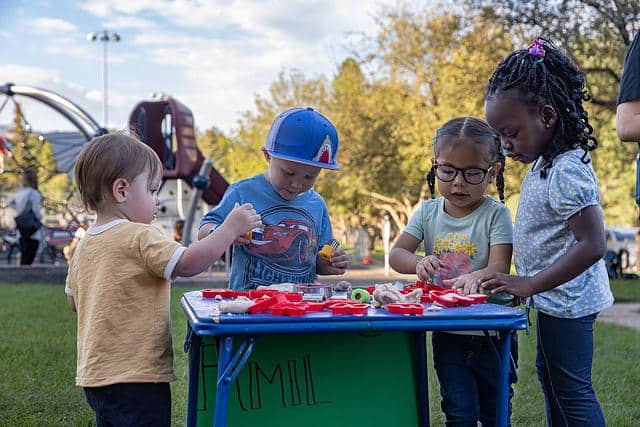
A peer-reviewed working paper published by the Inter-American Development Bank found that inquiry-based learning gives young kids a better understanding of subjects such as math and science, increasing their standardized test scores by up to 18%. Yet in the United States, there are few early childhood care centers using this learning model aside from a handful of pricey private schools.
Inquiry-based learning found its way to northern Arizona thanks to Tori Damjanovic, then a Ph.D. student at the University of South Florida.
“In my doctoral studies, I was particularly drawn to research and educational models from Scandinavian and Nordic countries, where inquiry is not seen as an ‘add-on,’ but as the foundation of learning,” Damjanovic said. “In these contexts, children are viewed as capable thinkers, problem-solvers and contributors to their learning communities. That perspective deeply resonated with both my research and my experiences working directly with young children and educators.”
Damjanovic, now an assistant professor and incoming chair of the Department of Teaching and Learning, said the model works because young children are inherently curious. They learn best by asking questions, testing ideas and making sense of the world through hands-on exploration.
“When educators build on that curiosity rather than replacing it with predetermined answers, children develop deeper understanding, stronger language and critical thinking skills and a greater sense of agency,” Damjanovic said. “They are not just memorizing information; they are constructing knowledge in ways that are meaningful and lasting.”
ELDC’s growing community
Ever since Damjanovic’s vision came to life at the ELDC, her theories have been proven right. Last year, 100% of families said they were extremely satisfied with the center, and despite expanding enrollment by 40% since 2023, the center still has dozens of families on its wait list.

The ELDC also recently received accreditation from the National Association for the Education of Young Children (NAEYC), the highest recognition possible in early childcare. At their first NAEYC conference, center staff gave talks that drew wide interest and attention from educators across the country. And a recent one-day workshop led by Cirzan and her colleagues attracted so much interest that the ELDC is planning to host a national conference on the subject on campus April 18.
“We had a wait list of people trying to get into the workshop,” Cirzan said. “Then, at the NAEYC conference, a lot of educators heard our talks on inquiry-based learning and said, ‘This is incredible; I didn’t know we could teach like this.’ We’ve had people circling back to us and asking for more information. It’s clear people want to hear more.”
Interest in the ELDC isn’t just coming from the education sector—it’s also coming from local government. The Flagstaff City Council and Coconino County Workforce Development Board recently asked Cirzan to give a presentation on the connection between childcare and economic development, which Cirzan hopes translates to policy changes that help the community thrive.
“A lot of people don’t realize that when children don’t have access to high-quality childcare, we see destabilization in households and the workforce,” she said. “We treat childcare as something families need to figure out on their own, but we need to flip that script. Childcare should be a community resource.”
A living laboratory
Inquiry-based learning isn’t the only thing that makes the ELDC unique. Since moving from a cramped Flagstaff Middle School building to a larger location on NAU’s Flagstaff mountain campus, the center has also grown to become a hub for NAU research that benefits both early childhood researchers and young children.
Nursing Lumberjacks have used the ELDC as a training ground, doing some of their required rotations there to prepare for careers in pediatric care. Graduate students in speech language pathology have provided interventions in group and one-on-one settings to improve speech and language delays ELDC staff have identified in some children. Some of Arizona’s future art and music teachers have come to the center to exercise the children’s creative muscles and gain valuable classroom experience.
And of course, some of the center’s own teaching staff are undergraduate and graduate students in the College of Education.
“It’s a unique opportunity for students to build real-life job skills,” Cirzan said. “Most first-year teachers feel overwhelmed with things like classroom management and student behavior, but we’re giving them the tools to deal with those things now, which means they’ll be way more prepared going into their first year of teaching.”
Last year, Marisa Edrozo, an Honors College student, won a Hooper Undergraduate Research Award to study ELDC teachers’ experiences with culturally sustaining pedagogy—that is, teaching that helps underscore the importance and value of kids’ own cultural practices and traditions.
Cirzan said Edrozo’s work helped inspire one teacher, a native Spanish speaker, to change tactics in the classroom.
“When she came to the ELDC, she said she wasn’t going to speak Spanish to any kids in the classroom,” Cirzan said of the teacher. “I said, ‘We have kids who speak Spanish, and you can if you want.’ We worked through this process of building her comfort in matching the cultural needs of the kids. Marisa’s research helped her take components of her kids’ lived experiences and embed them into her teaching, which has actually helped her understand her own culture and background.”
What’s next for the center
In the years to come, the ELDC hopes to serve even more children in northern Arizona. That doesn’t just apply to its daytime teaching.

Last year, the center used grants to purchase a Welch Allyn Spot Vision Screener, a handheld device that can quickly detect potential vision issues in kids 6 months and older. Cirzan said the device has been a game-changer for spotting correctable vision problems in their own enrolled kids. Now, she’s wondering how to bring the device to more northern Arizonans who need it.
“A lot of our student parents are coming to us from rural communities and tribal lands, where they haven’t necessarily been able to test their kids in this way,” she said. “We’re trying to write for some grants to be able to expand those services beyond our walls, because we know there are so many more rural and tribal residents who might not otherwise have access.”
Cirzan said she also hopes to build on the ELDC’s existing research partnerships, perhaps even creating apprenticeship programs and residencies. She’s confident that more research on inquiry-based learning will only further support the theory that it builds more creative, resourceful and resilient communities.
“We really want to be a nationally recognized hub that shows what’s possible in early childhood education,” Cirzan said. “Traditionally, early childhood education has not been treated as a profession, but we have the ability to demonstrate to policymakers and educators that that needs to change.”
Jill Kimball | NAU Communications
(928) 523-2282 | jill.kimball@nau.edu