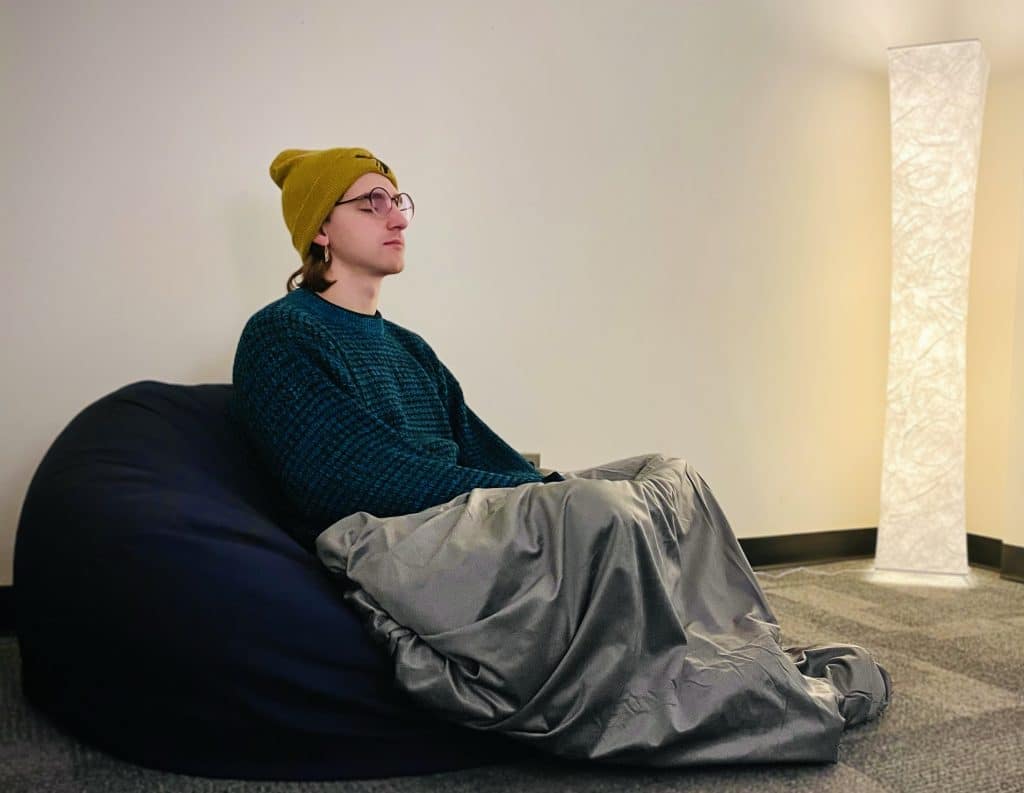


With rates of student burnout, anxiety and sensory overload on the rise, learning institutions are looking for ways to support mental health on their campuses. A new sensory room at NAU’s Institute for Human Development (IHD) is hoping to do just that by providing a quiet, controlled space designed to help students rest, refocus and regulate.
For neurodivergent students in particular, this type of space can mean the difference between pushing through a class and shutting down completely.
“Neurodivergence originally started as a term that meant low support needs, autistic individuals,” said John Schaffer, academic program coordinator at IHD. “It has now grown to include more people whose brains operate outside the typical brain. Providing these types of rooms on campus is important because they give students a space to go if they feel a little overwhelmed and need to collect themselves to get ready for their next class or to go do their homework.”
Schaffer said the sensory room at IHD has been years in the making. Finding a space and securing funding proved to be a challenge.
“A lot of us wanted this to happen and have been working on the concept for years,” he said. “IHD had received a grant from the Vital Project Fund, and I thought we could allocate some of the funds to the sensory room. After securing the funding, I realized we had an open office at IHD, so I approached our director, Kelly Roberts, about the possibility of setting up a sensory room in our building. She approved the project, and we began building a team to make it happen.”
From concept to reality
Amber King, executive assistant at IHD, worked on getting the necessary approvals, purchasing the required items and getting the room set up, while Sean Kugler, a neurodivergent individual who works as a digital accessibility analyst at NAU, worked as a consultant designer for the room.
Kugler was part of the group that initially envisioned the sensory room at NAU and is thrilled to see it is now a reality. He believes it will not only provide individuals a quiet space to relax and regroup, but also a place where students can just be themselves, which he feels is one of the main challenges neurodivergent individuals face every day.
“I think the need to fit in can cause neurodivergent individuals to mask,” Kugler said. “If we can be comfortable with who we are, it is easier for us to learn. We are not concentrating on masking, but on taking in what is around us and expanding our horizons.”
Kugler’s experience with sensory rooms started with self-contained classrooms in public schools about 20 years ago. The idea was to give students a break from sensory overload.
“Over the years, we have seen an expansion on that idea,” he said. “We are not always looking for sensory deprivation; we may be looking for a particular stimulus to help us cope with the things that are overstimulating to us.”
The sensory room is unscented and has different lighting options in the form of floor lamps, so students can choose how much light they want. It also has sound machines that make soothing noises, fidget toys and different types of sitting options.
More than just a room
Roberts believes that providing this space reflects NAU’s commitment to supporting the whole student.
“We are thrilled to be opening the sensory room,” she said. “Everyone often needs a space to simply exist and decompress from the overstimulation that tends to be life today.”
This effort is a recognition that learning doesn’t happen in a vacuum and that, sometimes, the most meaningful support a learning institution can offer isn’t academic, but sensory, emotional and deeply human.
“At NAU we are differentiating ourselves by creating an area that can make students feel more comfortable,” Kugler said. “It goes with the concept of anti-fragility President Cruz Rivera talks about. It is not an expensive concept and provides us with a really simple solution that, in reality, can give us much more in return, including a sense of belonging.”
 Mariana Laas | NAU Communications
(928) 523-5050 | mariana.laas@nau.edu