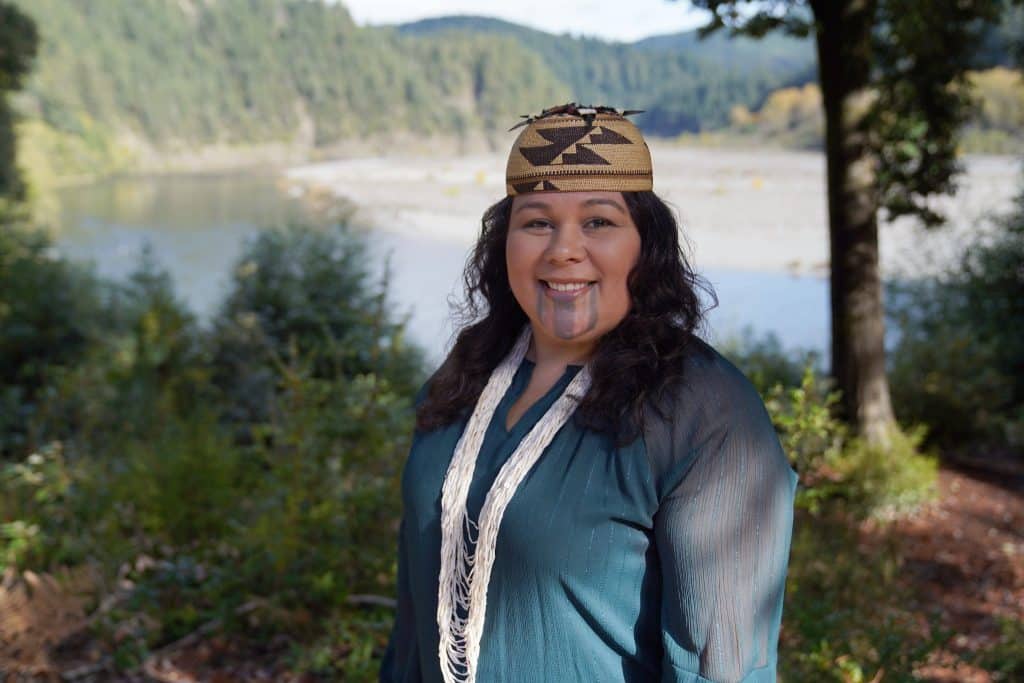


Principal investigator of NAU’s Wildlife, Environmental Stewardship and Indigenous Peoples (WESIP) Lab Seafha Ramos’ recently received the Native American Fish and Wildlife Society’s 2026 Biologist of the Year award in recognition of her unique interdisciplinary work. The assistant professor answered a few quick Qs about what the award means to her and how she’s using it to raise awareness of her lab’s important, specialized work.
Tell us a little bit about your work in the WESIP Lab.
WESIP works with Indigenous communities and management agencies to support effective, collaborative wildlife research and conservation. We use field, laboratory and molecular ecology approaches across a wide range of partnerships—and when working with Indigenous communities, we weave science with community-driven engagement that honors Tribal sovereignty.
WESIP students are doing remarkable work. Master’s student Salix Scoresby is studying the diet of the rare Sierra Nevada red fox in Oregon, and Ph.D. student Destiny Sanderson is working with Kwaahu (golden eagles in Hopi) in partnership with the Hopi Tribe Wildlife and Ecosystems Management Program.
What does it mean to you to receive the Biologist of the Year award?
This honor recognizes not just my work, but the students, community partners, professional networks, my family and community and the institutional support at NAU that made it possible. I was drawn to NAU because of the deep alignment between my work and the university’s mission—particularly its commitment to Indigenous Peoples, student success and broad social impact. Receiving this national level award from peers across Tribal fish and wildlife programs means the world to me.
The award letter noted that my work “represents the strength, leadership, and dedication that continue to advance Tribal fish and wildlife stewardship across Indian Country.” I carry these words with great humility, and see that this recognition also demonstrates something larger: that rigorous, transdisciplinary, community-accountable Indigenous environmental science is legitimate and important.
How will you leverage this recognition to raise awareness for the importance of Indigenous environmental stewardship?
This recognition shines a light on a field that demands a rare and specialized skill set—my work weaves together wildlife ecology, molecular ecology, Indigenous research methodologies and federal Indian law, among other disciplines. Very few researchers are trained to work at this intersection, and it is important to create a pipeline of students prepared to enter conservation careers with Tribes or that engage Tribes. NAU’s location and mission give me a unique platform to contribute to these efforts.
Doing this work with integrity takes significant time and intention. The NAFWS Biologist of the Year award creates visibility for that reality, and I hope it will help attract the external funding and partnerships needed to sustain and expand our work in both conventional and Indigenous conservation science. I look forward to seeing what we accomplish together with our partners and communities!
Jill Kimball | NAU Communications
(928) 523-2282 | jill.kimball@nau.edu