

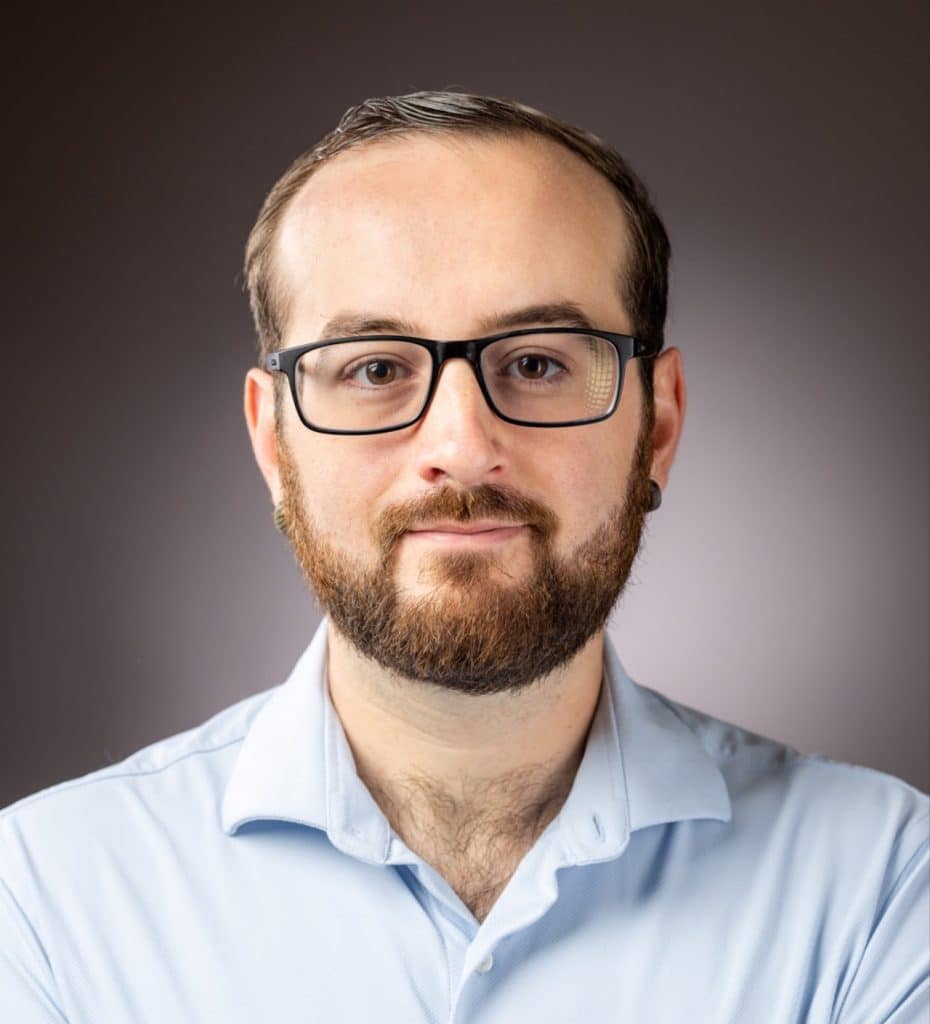
A new grant from the Flinn Foundation is allowing computer scientist Jared Duval to expand his work around making healthcare technology both effective and fun.
Duval, an assistant professor in the School of Informatics, Computing, and Cyber Systems, won the two-year, $300,000 grant to support his work in health-related research that benefits Arizona. His far-reaching work, which includes everything from helping people with disabilities better use their technology to tracking internet access in rural Arizona to speech therapy, all comes out of the Playful Health Technology Lab, which takes a broad view of health.
“Broadly, we think of our work as the intersection of those three words,” Duval said. “We’re pretty open with the definition of those words. We work on things that matter most to the community.”
What happens in the Playful Health Tech lab
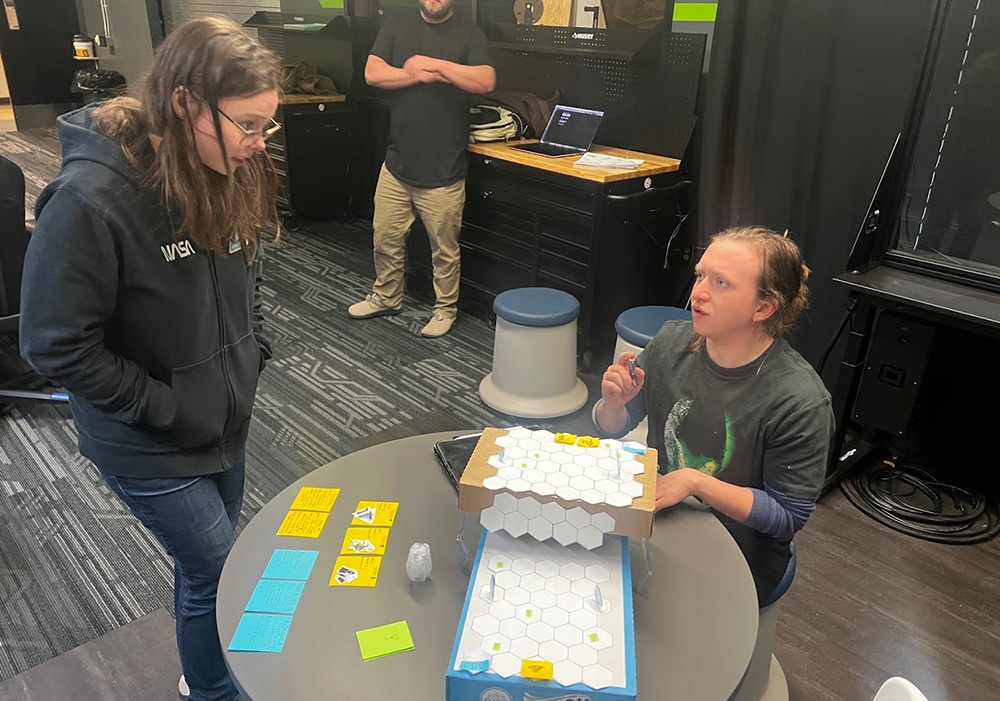
 Duval and his lab members, which includes 15 graduate and undergraduate students, design tech that can be used with little knowledge, that can be adapted to different users’ needs and that uses low-cost, ubiquitous technologies that just about everyone can access.
“We design, develop and test playful probes that are designed in a way to target a specific health outcome, but do so in a way that requires the least amount of engineering possible,” Duval said. “We design intentionally with ambiguity built in, so that way people can appropriate the technology for their own use cases. It makes it flexible, so it can work in lots of contexts and lots of places.”
The projects have dual outcomes: The first is improved health for the users and their community. The second is data for the researchers and a better understanding of population health, because those data inform future projects and areas of study.
“We don’t have very many insights into what happens at home,” Duval said. “We want to know how people are trying to improve their health and how we bridge what’s happening at home and what’s happening in the clinic. So we collect data from these technology probes to gain a better understanding into what interventions work in the homes.”
His work also includes cultural probes to better understand how tech needs to be designed—in one way for Diné people, in another for children with autism.
But what does Internet access have to do with health?
NetGauge, one of the lab’s ongoing projects, allows users to create games using Twine, a simple game-building tool that gets players out and moving to specific places. In each location, the player collects a measurement of the broadband coverage in that place to progress in the game. This has meant hundreds of people are roving around rural Arizona, collecting data on where they can and can’t get broadband.
This matters, Duval said, because broadband coverage is spotty in the western United States. The Federal Communications Commission (FCC) has coverage maps, but the companies overstate their coverage. The only way to challenge those maps is to demonstrate, using data collected from multiple people in the same places over time, that those areas don’t have coverage. Which is exactly what this game is doing every time someone plays.
“Internet is a structural determinant of health,” he said. “If you don’t have internet, you can’t do telemedicine, you can’t gain access to jobs, you can’t do remote education. Internet is a human right, and people don’t always see it that way.”
Much of his work at NAU also has been funded by the Southwest Health Equity Research Collaborative and supported by the investigator core.
Learn more about other projects in the Playful Health Technology Lab.
Reaching out to the community
Duval’s newest project, which is possible because of the Flinn funding, is the inaugural Hozhoni Game-o-Rama, a collaboration with Hozhoni Foundation, a local disability service provider. They will invite all of Hozhoni’s clients and their families, staff and the board of directors to a day of exploration and experimentation. Guests can try all seven of the different technologies coming out of the Playful Health Technology Lab, and students will do workshops for each of the stations and help participants use the tech. At the same time, Duval and his team will get valuable feedback on what works and what can be improved, which will inform future grant proposals.
Duval is particularly excited about a demo app for a robot arm, which he’s tentatively calling Robomoji. People who use wheelchairs can get a robot arm attached to their wheelchair to help with daily tasks. Historically, however, there’s a stigma around these robot arms. So Duval wanted a way to make the arms seem more friendly and give users more agency over their tech.
Enter Robomoji. Users will have an app and they can input an emoji. The program will then tell the arm how to put that emoji into playful motion. It’s a complex technical feat—“how do you turn a single character into a 3D motion?”—but the result will be a way for people to express themselves creatively and reduce the robotic stigma around the arm. For instance, you can put in (that’s a head-exploding emoji) and the arm will move to indicate the person’s head exploding. (The writer went when Duval explained it.)
“The whole idea behind this is that people need to have a simple way to exert agency over the arms so the arms are an extension of themselves,” Duval said. “It’s hard to control arms with seven degrees of freedom. That’s more than the human arm has! It moves in ways that people’s arms can’t move. How do you communicate with something that complex in a fast and intuitive way?”
How Duval got here
There are lots of practical reasons for making healthcare in the United States more affordable and more accessible. But Duval’s foundation for this work is personal. When he was growing up, his mother worked at a day program for people with disabilities, and his father was a shared living provider for a man named Timmy, who lived in their home and needed full-time care. As a teenager and young adult, Duval was a respite care provider for Timmy, whom he sees as a brother.
Though he went to college for computer science, he knew he wanted to work in this space. His dissertation included working with the Swedish organization Cirkus, which uses games to help children with sensory based motor disorder develop better flexibility, strength, endurance and movement coordination. The students moved like animals, while Duval used accelerometer data to train machine learning models to recognize the movements.
“As academics, we have been operating under the western medicine model of health, which is important research,” he said. “But what we were missing was the translational integrative research that looks beyond just the clinical outcomes and thinks about health more holistically. That’s what my lab does—we think about the whole-person experience, not just the condition you have.”

Heidi Toth | NAU Communications
(928) 523-8737 | heidi.toth@nau.edu