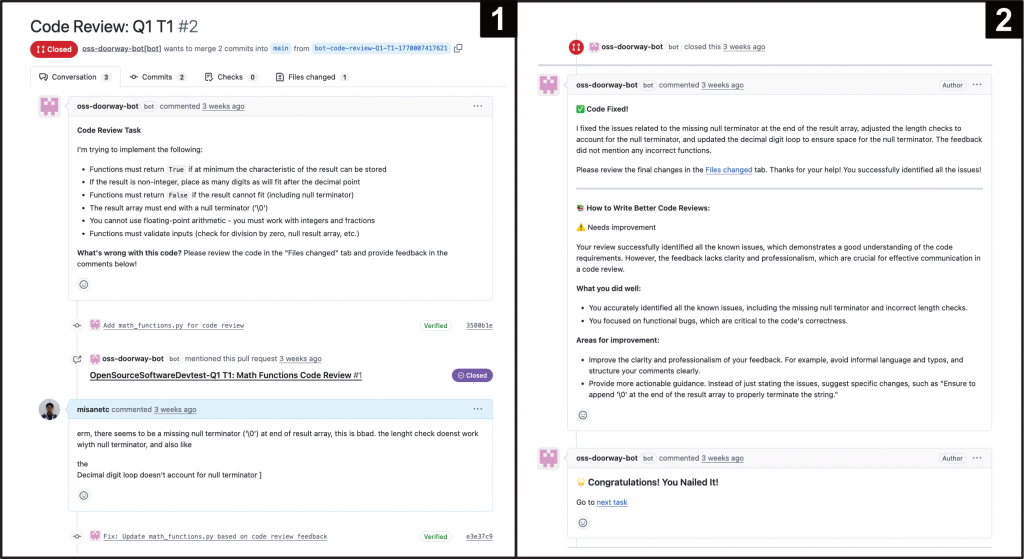


A recent project from Northern Arizona University demonstrates that, if you can make learning how to contribute to real-world open-source projects fun, students will learn more effectively.
OSS-Doorway is a platform aimed at helping students learn to how to contribute to open-source projects using GitHub workflows through quests, tutorials and structured tasks, all done at their own pace. Northern Arizona University professors and students created the platform, which is funded in part by a National Science Foundation grant, with the goal of lowering the barrier to open-source participation, especially for beginners and students from groups who are historically underrepresented in tech fields.
“We aim to help newcomers understand the OSS contribution model step by step, starting with non-code contributions and progressing toward more technical ones,” said Igor Steinmacher, associate professor in the School of Informatics, Computing, and Cyber Systems (SICCS) and co-principal investigator on the project. “We want to increase students’ confidence, sense of belonging and self-efficacy in collaborative software environments.”
What is OSS-Doorway?
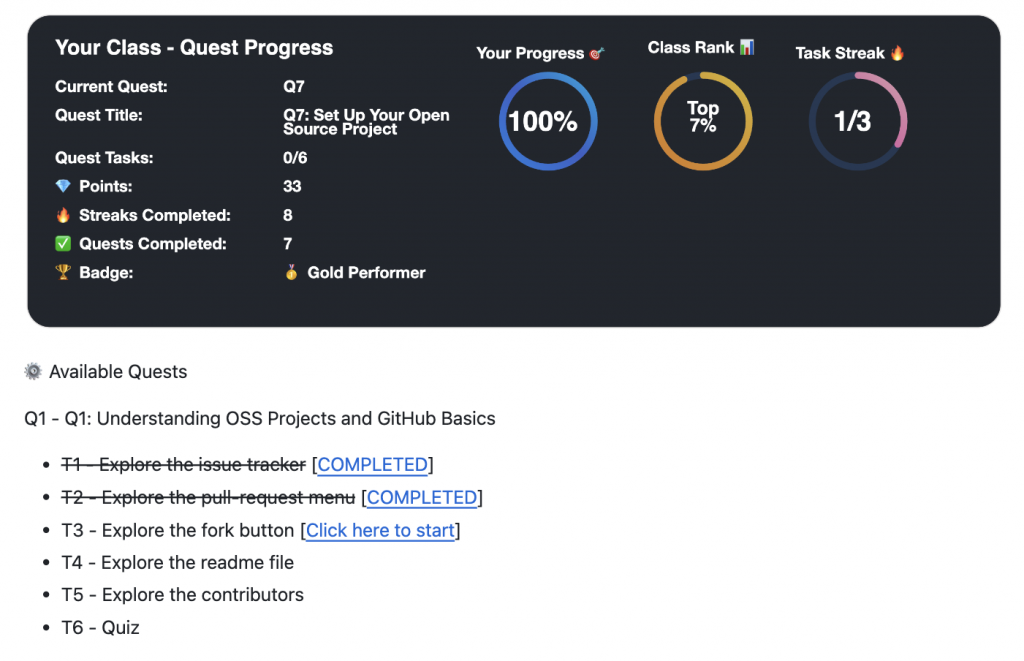
OSS is short for open-source software, which means source code is publicly available and anyone can change and distribute it. OSS-Doorway is a GitHub-native learning environment that guides users through “quests,” allowing them to practice key contribution activities such as navigating repositories, posting issues, setting up environments, interacting and submitting contributions to the site in a real-world environment. The system is self-paced and feedback-ready; the quests teach real skills and provide education while being interactive and fun.
The platform also integrates AI-based feedback to generate contextual hints and guidance in real time, allowing students to iterate on their work and better understand the contribution process without leaving GitHub
This platform helps, Steinmacher said, because a lot of people don’t know where to start or what resources to use to learn coding or GitHub itself. OSS Doorway keeps all the activity inside GitHub, breaks complex workflow into manageable tasks and provides immediate feedback.
It provides a guided pathway through real GitHub workflows, as demonstrated in two different classrooms; students reported more engagement, more familiarity with GitHub and greater confidence in their ability to work with and contribute to OSS.
“Gamification in OSS-Doorway supports pacing, orientation and motivation through unlocking levels, cooperative tasks and timely clues,” Steinmacher said. “The goal is engagement and persistence, not competition.”
In addition to Steinmacher and co-PI and SICCS professor Marco Gerosa, the team includes current and former students:
- Jadyn Calhoun (former undergrad)
- Karissa Smallwood (master’s student)
- Tomas Jauregui (alumnus)
- Connor Aiton (alumnus)
- Aaron J Santiago (alumnus)
- Kristiana Kirk (alumna)
- Italo Santos (Ph.D. alumnus)
- Pedro Oliveira (Ph.D. student)
- Misan Etchie (master’s student)
Embracing the openness of open-source
The inaugural platform is GitHub-native, but in a meta turn of events, OSS Doorway is itself open-source software, so future users could adapt it to other coding platforms. The design principles, tasks and inclusivity mechanisms could be reworked for use on other collaborative platforms.
“A defining aspect of OSS-Doorway is its explicit focus on supporting people with different backgrounds and needs,” Steinmacher said. “The project is not only about teaching GitHub—it’s about redesigning onboarding to be accessible and learnable from the start.”