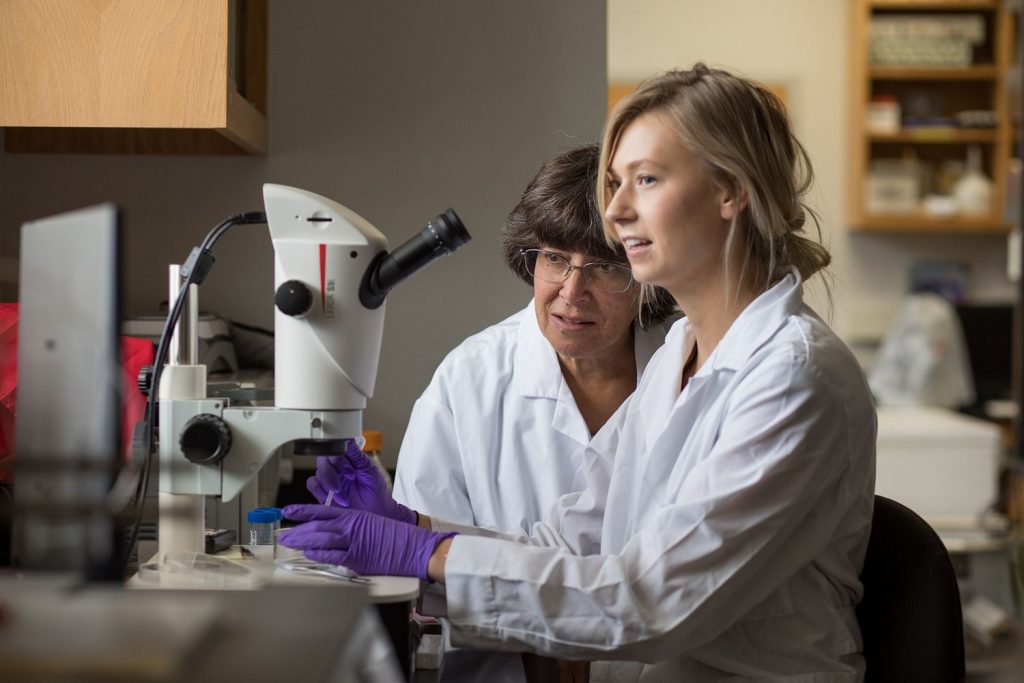


A grant awarded to Northern Arizona University and Diné College promises to help make careers in STEM—science, technology, engineering and math—more attainable for all Arizonans.
With nearly $500,000 from the Alfred P. Sloan Foundation, science faculty at the Navajo Nation-based Diné College and NAU’s Yuma and Flagstaff mountain campuses will create mentoring and enrichment programs that help STEM students from all backgrounds, particularly those who are the first in their families to go to college, explore postgraduate pathways, complete graduate degrees and find high-impact careers in the Grand Canyon State and beyond.
Catherine Propper, a professor of biological sciences at NAU, said the grant funds will help faculty build on previous grant-funded work that expanded students’ access to STEM education through an undergrad-to-grad bridge program, a revised admissions process and more.
“While the first grant project was focused on increasing access to STEM education—and it worked!—this second project is more focused on making sure students are prepared for graduate work and careers in STEM,” Propper said. “What does it mean to read and evaluate scientific literature? How do you make a presentation sharing the results of your research project? What proactive steps can you take to do well in the job market? These are the kinds of skills we want our STEM students to have when they go out into the world.”
Propper said she and her colleagues first took on this work in 2022 after observing the paths of first-generation STEM students at the Flagstaff mountain campus. Faculty noticed that many first-generation undergraduates weren’t considering attaining an advanced degree, either because they didn’t know it was an option or because they weren’t aware another degree could lead to better career outcomes and higher pay. And many of the students who did advance to a Ph.D. program after graduation weren’t prepared for the lab work and literature reviews that awaited them.
“Students who come from undergrad straight into a Ph.D. program may not even understand what graduate school is about,” Propper said. “When they get there, they may feel overwhelmed, and that leads to pipeline failure. We gave a cohort of students in Flagstaff an intermediate step, a bridge, that helped them navigate the complexity of the graduate program.”
Three years later, the bridge program is expanding to include students at Diné College and NAU Yuma. A cohort of STEM students from all three campuses will have access to synchronous online mentorship that creates a bridge between undergraduate and graduate education, exposing a wider variety of students across the state to the career possibilities a graduate degree can provide and information they’ll need to succeed in the job market. Students across the three campuses will also have opportunities to come together for in-person, hands-on experiences. The grant will even fund engagement opportunities with students’ families, which will help loved ones understand and support students’ journeys through graduate school.
By expanding the program to other locations across the state, said Diné College biology Chair Donald Robinson, students living in smaller cities will have a chance to access research, lab training, field trip and networking opportunities in Flagstaff while staying rooted in their home communities.
“For Navajos with close family ties and working locally, in a unique culture, being able to get a graduate education close to home on the reservation is easier and more comfortable,” Robinson said. “Also, students with a graduate education are likely to have stable careers that further help their families and communities in the long term.”
Bringing students from multiple campuses together, Robinson said, doesn’t just give everyone in the cohort a chance to learn more about the wide range of scientific research happening across Arizona. It also exposes them to a greater variety of experiences, perspectives and backgrounds, which could help them tackle scientific questions with an open mind.
“It will provide all students, at NAU-Flagstaff, NAU-Yuma and Diné College, the additional richness of intercollegiate experiences,” Robinson said. Just as Diné students will benefit from interaction with NAU, “NAU students and faculty will benefit from exposure to our labs and faculty and students, and importantly, our Native Navajo culture that is rich and meaningful historically, intellectually and socially.”
Jill Kimball | NAU Communications
(928) 523-2282 | jill.kimball@nau.edu