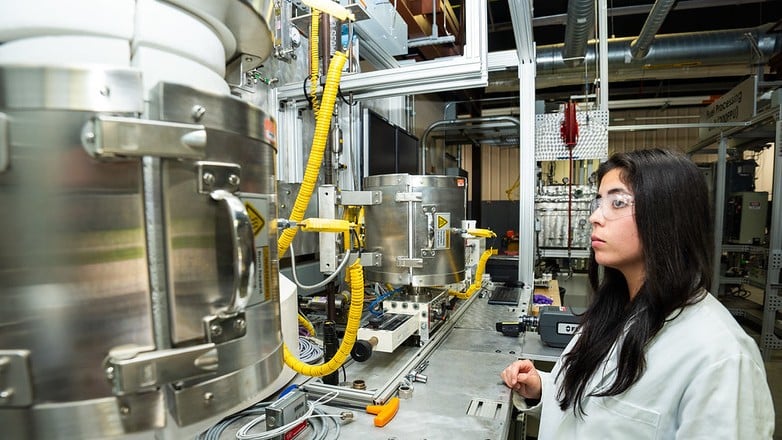


Ashley Martinez was not interested in doing research.
When she was an undergraduate biology student at NAU and struggling in her classes, the thought of adding more work was overwhelming. She approached research reluctantly, finally deciding to do it “just so I could say that I tried it.” She found a Hispanic woman doing research in a related field and sent her an email.
Jennifer Martinez, then a professor in the Department of Applied Physics and Materials Science (APMS) and director of the Center for Materials Interfaces in Research & Access (¡MIRA!), responded. She invited Martinez (no relation) to work in her lab, and everything clicked. Putting science to work made so much sense to Ashley Martinez.
“I was able to use research to ease my stress from my courses,” she said. “I’ve had experiments not work or show different results than expected, and at times, it was frustrating. But I know they can be solved one way or another.”
After years of materials science research, Martinez, now a third-year doctoral student, was selected for the National Science Foundation’s Graduate Research Fellowship Program (GRFP), one of the most prestigious awards in the nation for researchers. It’s a well-deserved recognition, said Gabriel Montaño—an APMS professor, ¡MIRA! director and Martinez’s adviser.
“Ashley entered the lab and ¡MIRA! curious about research but uncertain about her future,” Montaño said. “What she found was a passion for research. What we found was a remarkable student who was just tapping into their abilities. From the beginning, Ashley demonstrated a natural curiosity and inclination to perform research, and since that time has been like a rocket soaring to new heights.”
Her undergraduate time at NAU
 Martinez, who grew up in Texas, struggled when she arrived at NAU. She had a hard time in her classes, and despite tutoring, student instructor sessions and going to office hours, she couldn’t translate what she understood in those environments to taking tests. Even with low grades, however, she was determined to earn her degree.
Then two things changed for the better. The first was finding research, which she started in 2020. Martinez’s first project was to create polymer carriers that would transport DNA vaccines to immune cells. It required precision, trial and error and lots of failure. And she loved it.
Just before starting her senior year, Martinez also realized she had intense test anxiety and was diagnosed with ADHD. Both discoveries helped her understand why she struggled so much with exams but not with the concepts. She implemented various strategies, including word association and the Feynman technique, and asked for exam accommodations. It didn’t fix her GPA from earlier semesters, but these adaptations did help her to better understand her learning style and needs.
Her place in the lab
Martinez is working with synthetic versions of elastin, a protein that resembles a rubber band in that it returns to its original shape after stretching. It occurs naturally in the body and gives organs like the lungs, heart and bladder the flexibility to stretch and recoil through a person’s lifetime. This project aims to create polymers that can assemble themselves into sturdy, flexible membranes and could then be used in therapeutics and drug delivery, advanced biosensors and sustainable materials that take the place of petroleum-based plastics.
 In her time at NAU, she also has worked on research to use biodegradable polymers to build nanocarriers that more effectively transport DNA vaccines to immune cells. That work creates the possibility of safer and more effective vaccine delivery systems.
And Martinez isn’t just doing her own research; she also shares her love of science with the community. As an undergraduate student, she started working for SparCQS, an NAU program designed to teach children and other community members about the potential of quantum science. She still volunteers at their outreach events as a grad student.
Tackling the GRFP process
Every year, thousands of graduate and undergraduate seniors who want to go to graduate school apply for GRFP funding and support. The selection process looks not only at the research but also at the researcher. Applicants only have a few pages to tell their personal story and their research story, and the application can be a monthslong collaborative process.
Martinez, who received the award the first time she applied (students can apply twice), took a grant-writing class, which helped her break down the application into manageable parts. Once written, she got feedback from peers and mentors and made multiple revisions before she was satisfied.
“I found the personal statement to be the most challenging portion, as it feels uncomfortable to write about yourself,” she said.
Her advice to the next class of applicants? Start early; it’s a long application, and you’ll want time to brainstorm, make edits and take breaks.

Heidi Toth | NAU Communications
(928) 523-8737 | heidi.toth@nau.edu