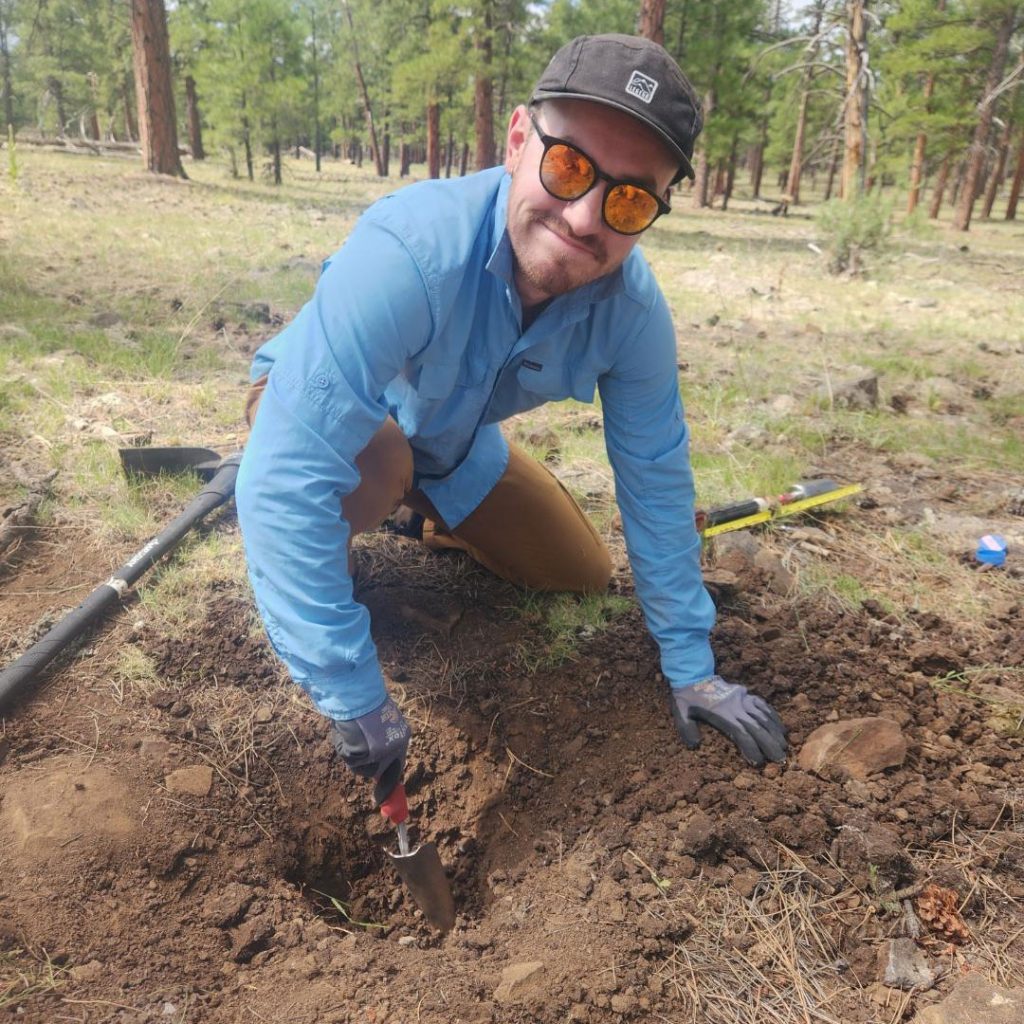


Did you know that 95% of Arizona’s precipitation evaporates before it can be used by communities and ecosystems? Caelum Mroczek, a Ph.D. student in the School of Earth and Sustainability, is one of many local scientists who is trying to change that.
As part of a multi-university project aimed at protecting and enhancing Arizona’s groundwater supplies, Mroczek analyzed data from 205 river monitoring stations across the state to understand how Arizona’s base flow has—and hasn’t—changed over time. Then, he and his colleagues used machine learning to predict how changes in rainfall and temperature might affect groundwater across the state in the future. The student hopes his findings, published in the Journal of Hydrology: Regional Studies, will help policymakers and scientists manage Arizona groundwater more effectively.
Mroczek answered three quick Qs about his work.
Tell us how you used AI to study how water flows through Arizona.
I used a machine learning technique to combine decades of streamflow records with climate and landscape data to investigate how much of Arizona’s rivers are fed by groundwater. This technique allowed us to fill in the gaps in areas without monitoring stations, giving the first statewide picture of groundwater contributions to streams.
How could the study make a positive impact on Arizona?
This study can help communities and decision makers better understand where water is most at risk from climate change and overuse. By showing which rivers depend most on groundwater, it provides insights that can guide water planning, conservation and resilience across Arizona. In addition, this work helps elucidate the interconnection of groundwater and surface water throughout arid regions.
What’s next for you?
For this project, I’m working with the Kyl Center for Water Policy at ASU to make these data publicly available on the Arizona Water Blueprint in an interactive format to help inform smart decisions about Arizona’s future water security. My next project will investigate how headwaters across the Western U.S. have changed historically and will change in the future.

Jill Kimball | NAU Communications
(928) 523-2282 | jill.kimball@nau.edu