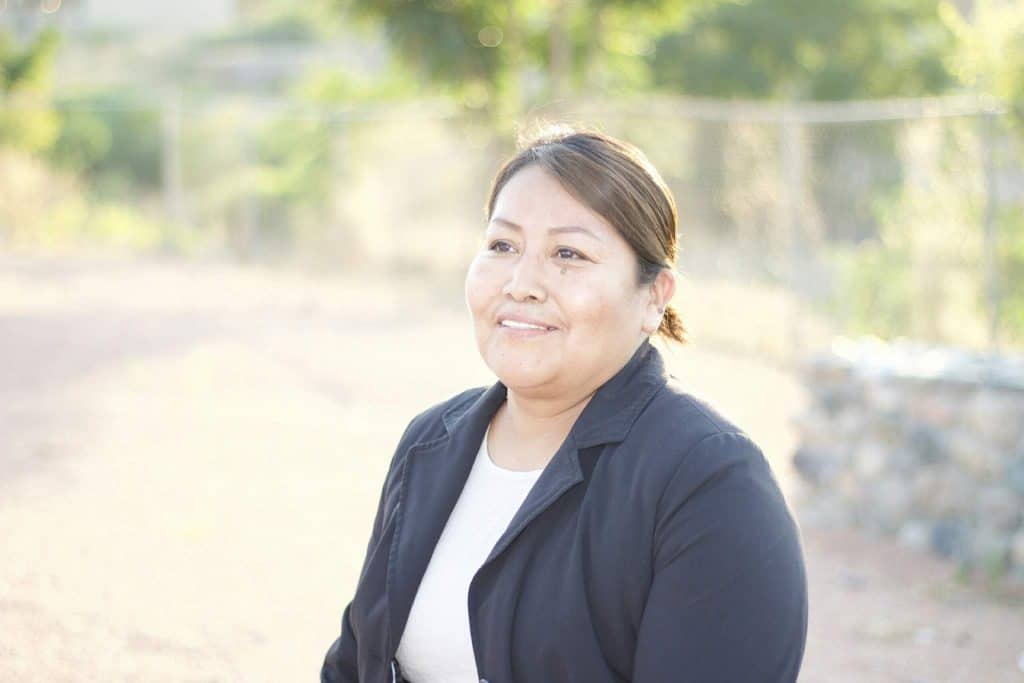


Thomasene Cardona, a graduate student in the Applied Indigenous Studies program, hopes to help her community reconnect with its roots. With the help of the Maxwell Lutz Community Impact award, she started the Yavapai Land and Culture Collective project, along with Emanuel Preciado, assistant teaching professor in the Department of Geography, Planning, and Recreation. The goal: to reintroduce the Yavapai tribal community to their sacred areas.
Why did you choose NAU?
I chose Northern Arizona University because of its commitment to place-based education—an approach that recognizes the landscapes and histories we study as inseparable from the ones we inhabit and are accountable to. NAU’s location on ancestral lands offers an education that is contextual and experiential, grounded in the realities of place. This deepens not only what I learn but how I carry that knowledge forward, applying it to community wellbeing, stewardship, cultural resilience and governance in ways that are responsible and enduring.
Tell me about the Yavapai Land and Culture Collective project.
The Yavapai Land and Culture Collective is grounded in the belief that education must be rooted in land, memory and community. It is a space where elders, scholars, youth and community members come together to learn from the land, from oral histories and from one another. In this space, theory and practice are not abstract concepts; they are lived experiences —just as they were for the original stewards of these lands long before university walls existed. This work honors and uplifts the voices and records of our people—from oral histories of the Yavapai preserved through elders’ testimonies to academic archives housed in places such as the Arizona State Museum. In works like Oral History of the Yavapai, elders such as Mike Harrison share stories, songs and sacred knowledge as they remember them, creating living anchors for future generations. These records remind us that learning is not confined to classrooms or texts; it lives in how we move through land, language, memory and relationship.
How do you think it will impact the community?
It transforms relationships—between individuals and ancestral lands, between students and elders, and between community and academia. By stepping onto land with elders, hearing songs in the language and engaging oral histories alongside documented cultural archives, we create shared spaces of mutual learning and healing. This enriches educational pathways and fosters cultural continuity that respects both Indigenous knowledge traditions and contemporary scholarship.
What are your plans after graduation?
I intend to deepen my work at the intersection of community, culture and education, supporting initiatives that center Indigenous language revitalization, land stewardship and collaborative learning. I see myself working with communities, institutions and land-based programs to ensure that education honors place, memory, heritage and ongoing possibility—especially for young people who will carry these teachings forward.
What did you want to be when you grew up?
Growing up, I always wanted to help people—to bring our voices into spaces that shape our collective future. I didn’t always imagine public service, but as a member of this community and a student grounded in place, service became a natural extension of my learning—a way to give back what I have been given.
What is your favorite childhood memory?
My favorite memories weren’t in classrooms—they were with elders on the land, listening to stories about places, songs that held history and teachings that cannot be found in textbooks. Those moments taught me that true learning is lived and shared.
What is your favorite way to spend a day off?
I spend my days off quietly—walking the land, listening deeply, talking with elders and learning from community members. To me, education is a continuum that doesn’t stop at graduation; it’s part of how I show up in the world.
What are three items on your bucket list?
- Help support a Yavapai language revitalization program—ensuring young people can speak, sing and hold our language as a living legacy.
- Collaborate with archives and institutions like the University of Arizona libraries, the Arizona State Museum and community oral history projects to make cultural materials accessible in ways that honor community protocols.
- Document and share place-based learning programs that connect youth with elders, land and language so future generations know that education is in people and place alike.