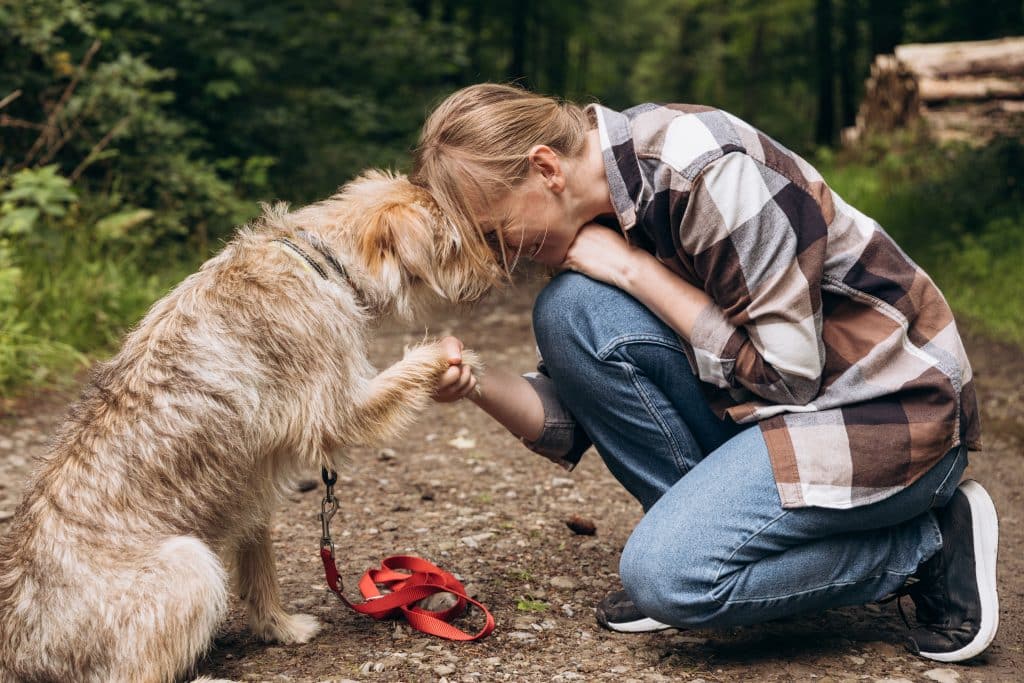


Humans have lived alongside animals for tens of thousands of years—hunting them, taming them, worshipping them and, more recently, dressing them in sweaters and giving them Instagram accounts. Anthropologists have been turning their attention to this relationship—not just how humans have shaped animals, but how animals have shaped what it means to be human.
Department of Anthropology teaching professor Chrissina Burke teaches the ANT 105 course Anthropology Today: Human and Animal Interactions at NAU, where students use anthropological concepts to learn about the relationship between humans and animals through time across the globe.
“As a zooarchaeologist, I study animal bones in archeological sites,” Burke said. “The idea for the class started as a way to engage with the relationships between humans and animals that are often inferred from those bones, using a cultural and linguistic approach, instead of only an archaeological one. It is a small subspecialty within anthropology called anthrozoology.”
The topic of the class allows students to have deep discussions and understand different points of view in a low-stakes environment. The course readings and conversations are guided by two questions: How do we engage with animals and use them in our cultures? And how do our relationships with animals support our success as humans?
Burke said the course covers interactions with animals through different disciplines, including biology, archaeology and anthropology. Students investigate how animals have influenced technology (think flying) and art (think the ancient drawings at Lascaux Cave in France).
“Throughout history, animals have been used as religious and political symbols,” she said. “They have been buried along with humans and have been a part of human history. In the class we also discuss zoos, testing on animals, Buddhism and vegetarianism, hunting and vegan choices and the evolution of keeping animals as pets.”
The class ends with an epic finale where students create an argumentative debate outline using a final question: Could humans be the cultural, emotional, innovative and successful creatures we are without the temporal and spatial relationships we have developed with animals? Student groups pick a side, do the research, create a presentation and show examples that support their argument. Later, they design a flag to represent their group.
“They work in groups all semester and learn how to discuss a topic, speak in front of a class and debate in a low-stakes environment,” Burke said. “I encourage my students to play devil’s advocate and try not to always agree with the arguments, to pick apart the questions and decide if they agree on all the different parts. This helps them engage and strengthen their resolve for the future.”
ANT 105: Anthropology Today: Human and Animal Interactions is offered every spring semester. For more information see the class catalog.
 Mariana Laas | NAU Communications
(928) 523-5050 | mariana.laas@nau.edu