


A grant from a regional First Things First program aims to streamline how families with young children receive help in the Coconino region.
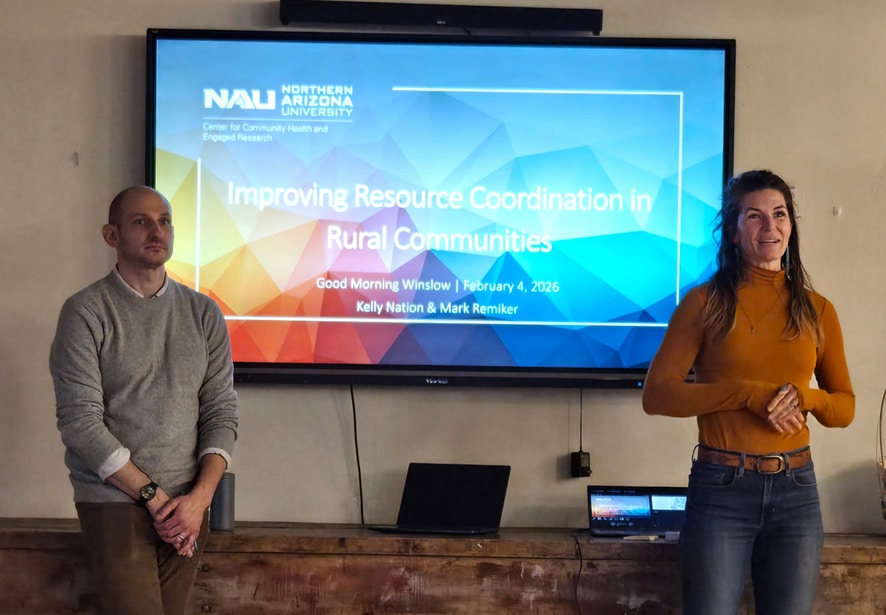
Research scientists Kelly Nation and Mark Remiker at the Center for Community Health and Engaged Research (CHER) are co-principal investigators on a project focusing on four towns—Williams, Fredonia, Page and Winslow—and their adoption and use of the CommunityCares portal. This statewide system integrates healthcare organizations (HCOs) and community-based organizations (CBOs) like food banks, housing service, mental health resources and more.
The overall aim of both Community Cares and this research project is to help children and their families be healthier and happier. The focus is on rural areas because they often face significant challenges with coordination across early childhood service providers, which can lead to unmet health needs, unidentified developmental delays and gaps in family support services.
“Access to health-related social needs—like food, shelter, education, employment and childcare— are essential to our physical, mental and social health,” Nation said. “Having our baseline needs met is important because when we don’t, we don’t have as much health resilience. It’s important from the public health perspective to be able to address those non-medical needs.”
This project, which began over the summer with information-gathering, is new, but it is replicating work that Nation and Remiker have done in the Yavapai region in the last several years. That group is looking at the collective impact of Community Cares throughout the county and how organizations can more fully integrate this tool.
Addressing social determinants of health
Health is complicated, multifaceted and often messy. A person’s health is determined in part by what we think of as health factors: genetics, behavior, access to healthcare and medication. But the large majority is related to those social determinants of health Nation mentioned: housing, food security, economic stability, a social network, social prejudice, education.
This means healthcare providers should have a vested interest in helping their patients address these needs as well. If a patient is seeing a doctor for an acute illness or a checkup, we want doctors and nurses asking about these other factors and helping those needs to be met as well.
“If someone comes in and says they’re food insecure, we want to make sure that they’re connected to somebody who can provide them with food, or housing or any other health-related social need,” Remiker said.
Currently, clinic staff can pick up the phone and call a food bank. But when the patient leaves, it’s hard to track whether they received the services, unless staff ask the patient directly. But with CommunityCares, a healthcare provider can make a referral to the food bank, and the food bank can mark it as complete when the client comes in. The loop is closed, the need is met, and there’s a record that can be followed up on if needed.
This can also be a helpful tool for public health surveillance. Researchers and healthcare providers can use that data to figure out the greatest needs in a community, where local resources are falling short and what’s hindering families from accessing these resources.
“Knowing what health-related social needs are common in our community and whether those needs are being met can inform community leaders on where to allocate funding,” Remiker said.
In the long term, healthier families may also lead to better overall health and wellbeing, including fewer visits to the emergency department, fewer missed school days for children and increased economic prosperity for families and the community.
“Coordinating care between healthcare providers and community-based organizations allows us to move beyond isolated services and toward a more connected, responsive system of support,” said Pearl Vasquez Santillan, Coconino regional specialist for First Things First. “Community Cares creates a bridge that helps families access resources through trusted relationships while giving partners a clearer picture of community needs. This kind of coordinated approach strengthens collaboration, reduces gaps in care and brings us closer to a system that truly reflects and supports the wellbeing of the people it serves.”
The first stages of this research
Remiker and Nation are starting with conversations with healthcare organizations and community-based organizations. In Yavapai County, that has meant both meeting with individuals and eventually bringing all the parties together into the same room to discuss the benefits.
What they found in Yavapai was a lack of familiarity with Community Cares and a fear that this is one more task an already stretched workforce will have to do. The researchers focused on the benefits not just to the community but to the organizations; the portal will make the referral process less complicated and, once it’s implemented, it’ll be less work to provide referrals.
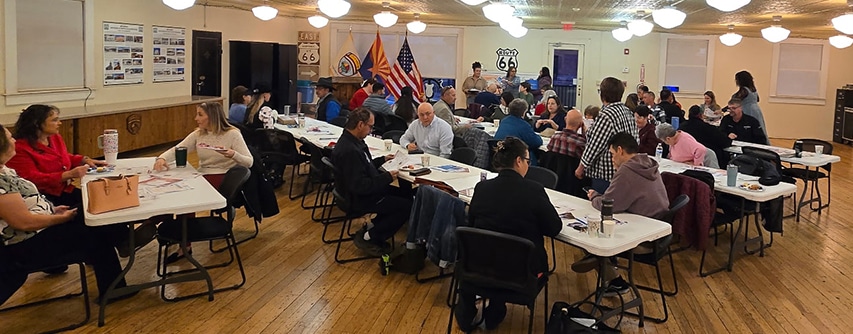
They’re also working with other community partners who use Community Cares and can talk up the advantages they’ve experienced. Even though the work is in its infancy in Coconino County, Remiker and Nation are seeing the same patterns—lack of awareness, cautious excitement, hesitance.
“The beauty and challenge of system change work is that it’s at the speed of relationships,” she said. “We have to slow down, learn why people are hesitant to use it, why they might be excited and bring people to the table and talk about it. We have to follow their pace.”
They’re both optimistic about what they’re seeing in Coconino County and excited as the project moves forward. This project’s focus on public health in the short and long term is a key piece of CHER’s mission. It’s also encouraging to do this work so close to home.
“We’re getting to do work for the community in which we live,” Nation said.

Heidi Toth | NAU Communications
(928) 523-8737 | heidi.toth@nau.edu