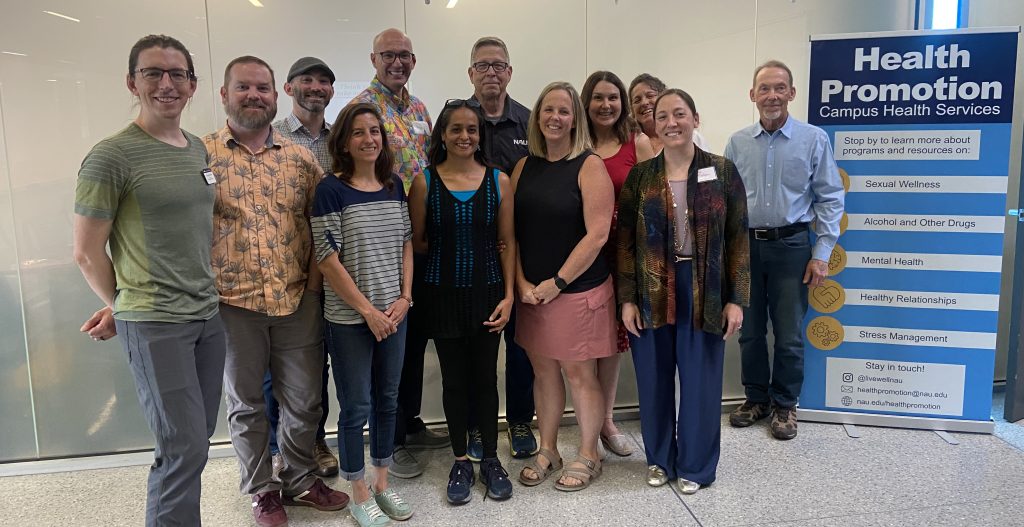


Across departments at NAU, faculty are rethinking what it means to educate the whole student. In response to rising mental health challenges among college students, a new initiative is helping professors integrate wellness practices into their courses—not just as add-ons, but as essential components of the curriculum.
The Faculty Wellness Fellows (FWF) program is a groundbreaking initiative where 12 faculty members, chosen from more than 100 applicants, will drive well-being efforts within their academic spaces.
This year’s Faculty Wellness Fellows are: Blue Brazelton, Charn McAllister, Lou Cirelli, Tim Curry, Aimee Fincher, Theresa Fuller, Nellie Gopaul, Paul Gremillion, Andie Lenhart, Anna Reber-Frantz, Melissa Schonauer and Jason Whetten.
Melissa Griffin, director of Health Promotion, said this is the first year NAU is offering the program. It’s inspired by a similar initiative at the University of Texas at Austin, where faculty well-being ambassadors have helped promote a culture of well-being in their classes.
“The idea behind the program is to provide a stipend to 10 faculty members interested in creating the conditions for well-being within their classrooms,” Griffin said. “Those selected attended a full-day training which addressed the need for student health and well-being in the classroom, effective strategies to promote health in learning spaces, how to identify and refer a student in distress and the prevalence rates of stress, anxiety and depression.”
The founding of the program, provided by a grant from the Arizona Health Care Cost Containment System (AHCCCS), allowed for only 10 faculty members to receive a stipend; however, two more professors joined the program without compensation. This, Griffin said, demonstrates that faculty are looking for ideas and strategies to help support student well-being in the learning spaces.
“We got applicants from literally every department,” she said. “Everyone, regardless of their discipline, is thinking about how they’re supporting students’ well-being in learning spaces. A lot of faculty members have experienced students coming to them in crisis and they want to know how they can help. This is incredibly kind and empathetic, and part of the solution. However, this program also challenges faculty to think about ‘upstream’ approaches to student well-being by taking a more preventative approach.”
Some of the strategies that are being incorporated in the curriculum include using specific language in syllabi. Professors can acknowledge the importance of students’ well-being and provide resources they might need to get support and stay connected.
“The physical space is also important,” Griffin said. “If they are teaching an in-person class, they can think about how the room can be arranged to create more opportunities for social connection. They can also take a moment at the beginning of the class for students to get to know one another. Building social connections and a sense of belonging at the university can be beneficial to wellness and academic success.”
Another key factor is sleep, since it is directly tied to academic success and mental health outcomes. Shifting deadlines from midnight to possibly 9 or 10 p.m. could allow students to keep a more consistent schedule for improved sleep hygiene. These are all small things faculty can do to prompt students to think about how they can take care of their own health and wellness, now and throughout their lives.
“We hope that the students who are in the Faculty Wellness Fellows classes will rate their perceptions of how the university is supporting their well-being as higher than the general population,” Griffin said. “Everyone’s interested in this idea. Faculty are clearly interested; ABOR is supportive and even healthcare organizations are supportive of the program. We’re hoping to be able to continue to build on this moment in the future and are incredibly grateful for our first cohort of Fellows.”
 Mariana Laas | NAU Communications
(928) 523-5050 | mariana.laas@nau.edu