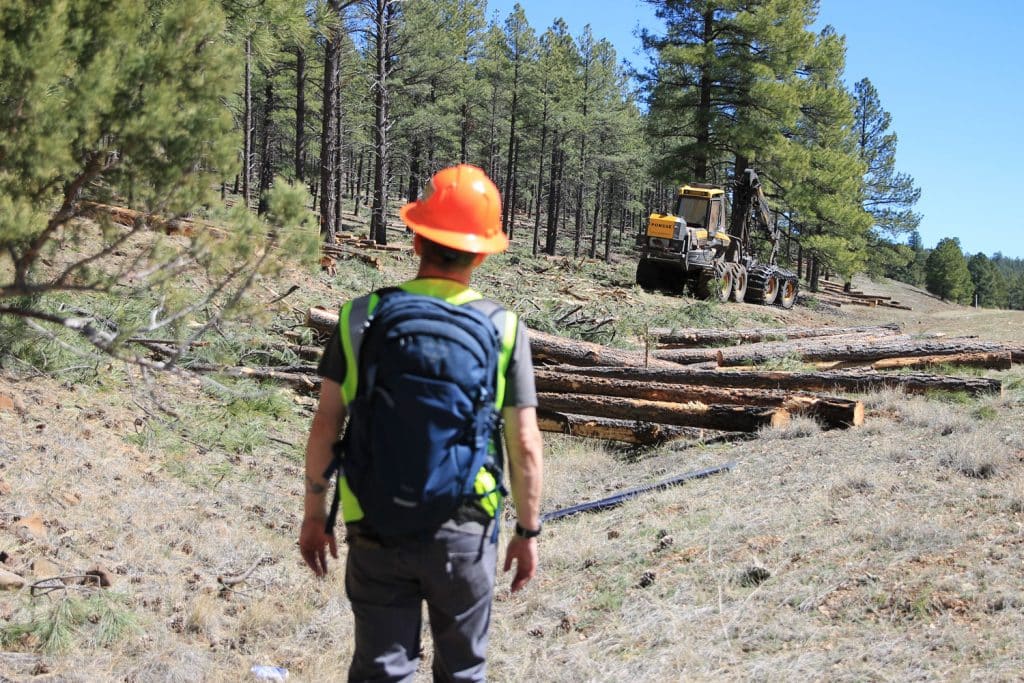


As the West faces increasingly destructive wildfires, land managers rely on mechanical thinning to reduce hazardous fuels and restore forest health. But one obstacle continues to slow this work down: Thinning costs are notoriously difficult to estimate from one project to the next. Uncertainty around those numbers raises concerns that outdated cost estimates may be holding critical restoration projects back.
That uncertainty plays out on the ground. When contractors can’t tell whether a project will cover their costs, many simply choose not to bid. Each unclaimed project means another patch of forest left overgrown, another season where communities stay vulnerable and another year where the risk of severe wildfire grows.
A new study from Northern Arizona University’s Ecological Restoration Institute, published in the Journal of Forestry, looks into that problem by examining how the U.S. Forest Service estimates the costs of mechanical thinning through its Transaction Evidence Appraisal, or TEA, method.
The researchers found that improving this cost-estimating system could make thinning projects easier and more affordable for the companies that do the work, ultimately helping accelerate the treatments needed to reduce wildfire risk in national forests.
“The better we understand where the big costs are, whether that’s cutting and loading trees or hauling them long distances, the more transparent TEA can be,” said ERI research associate Tucker Herbert, the study’s lead author. “That helps contractors plan and keeps their margins from getting too thin.”
For nearly 40 years, TEA has quietly shaped how forest restoration happens. The tool is designed to estimate the fair market value of timber on a project and account for costs like felling trees, loading logs and hauling them to the nearest mill. But the ERI team found that TEA’s data can become outdated quickly and that the tool doesn’t always reflect differences across landscapes, like how far logs must travel or how many mills are nearby.
Those details matter because timber removal and transport make up the vast majority of thinning costs. Much of today’s restoration involves removing small, tightly packed trees with little commercial value, so contractors need accurate numbers simply to break even. When cost estimates are unclear or don’t reflect actual conditions, contractors may walk away.
“When people don’t understand how the price for trees is set, sometimes no one ends up bidding,” Herbert said. “And that slows everything down, including the restoration work.”
The ERI study found that more than 90% of total sale costs came from just two factors: cutting trees and trucking them to a mill. In regions like the Rocky Mountains, where mills are few and far between, long-haul distances drove costs sharply upward. In areas with more mills nearby, such as northern Colorado, costs were lower, and contractors were more willing to take on projects.
“The tricky thing about TEA is that markets are dynamic,” Herbert said. “The system has to be updated frequently to reflect mill capacity, haul distances and changing product demand.”
But in the Southwest, researchers found that competition among bidders played an especially important role. Projects that attracted more companies were more likely to sell and move forward; fewer bids meant a higher chance of no sale and further delays. Sales involving more timber drew stronger interest, while projects requiring longer skidding distances (dragging logs to loading areas) deterred bidders who couldn’t absorb the added cost.
Improving TEA, the authors say, could help restore forests more efficiently across the West. In places like Arizona and New Mexico, where restoration depends on having enough companies willing to do the work, a clearer, more up-to-date appraisal system could bring more contractors to the table.
And more competition typically means better prices for the Forest Service—and more acres treated before wildfire risk escalates.
“We’re trying to make sure the system is transparent, consistent and grounded in real market conditions out there on the landscape,” Herbert said. “When contractors can trust the appraisal, they can bid with confidence and that’s how restoration moves forward.”

Danika Thiele | Ecological Restoration Institute
(928) 523-2851 | danika.thiele@nau.edu