

The answers to our solar system’s greatest mysteries could be locked away in distant comets and asteroids, each one preserving primordial materials that point to how the planets formed and which processes delivered water to early Earth.
These cosmic snowballs may be millions of miles away on average, but through a new citizen science project developed in collaboration with NAU and the University of Washington, volunteers can help scientists find these rare objects from the comfort of their home computers.
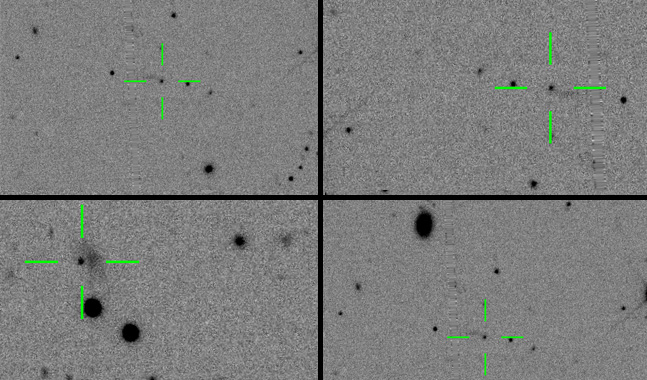
Launching on June 30, Rubin Comet Catchers features intel from the cutting-edge Simonyi Survey Telescope at the Vera C. Rubin Observatory in Chile, which is equipped with the largest digital camera ever built for astronomy. Volunteers use its unprecedentedly detailed dataset—consisting of images that each cover an area of the sky equivalent to 45 full moons—and the Zooniverse online citizen science platform to identify previously unseen comets, asteroids, centaurs and other interstellar objects.
Scanning photographs for small solar system bodies with comet-like features, including faint tails or diffuse halos, participants provide astronomers with invaluable information relevant to a range of topics from planetary defense strategies to the composition of interplanetary systems.
“With such a vast dataset, even the best algorithms miss what the human eye can still find, especially the unexpected,” said project founder Colin Chandler. “That’s where our volunteers come in.”
Chandler began researching for Rubin Comet Catchers and its predecessor initiative, Active Asteroids, while pursuing his doctorate in astronomy and planetary science at NAU. Now, as a planetary scientist at the University of Washington and a project scientist for the LSST Interdisciplinary Network for Collaboration and Computing, he’s continuing to work alongside his NAU mentors and colleagues to keep his project going strong.
One mentor is Chad Trujillo, an associate professor for the Department of Astronomy and Planetary Science at NAU. He, alongside doctoral students Max Frissell and Kennedy Farrell, contributed heavily to the project’s findings by conducting follow-up studies on comets of interest using the Lowell Discovery Telescope and the Vatican Advanced Technology Telescope in Safford, Arizona.
Trujillo also plans to utilize Rubin Observatory data to complete up to four additional investigations into the properties of nearby astronomical objects with School of Informatics, Computing, and Cyber Systems associate professor Michael Gowanlock and doctoral students Maria Chernyavskaya and Erin Clark.
“Comets and active asteroids are really interesting because the tails we see are mostly produced by water ice turning into vapor when they get close to the sun,” Trujillo said. “Studying them can tell us more about where water ice is in our present-day solar system, and it might provide clues as to where the Earth’s oceans came from.”
To make the most out of each Comet Catcher’s time, NAU doctoral student Will Burris developed a classification system to train an AI assistant named TailNet, which filters thousands of Rubin Observatory images to prioritize those most likely to showcase comet activity and remove ones that don’t.
Chandler’s archival investigations into past comet-like activity are also powered by NAU’s computing cluster, Monsoon, which he said supports the large-scale data mining critical to his citizen science initiative’s success.
Equipped with these tools and a passion for making cosmic connections, Chandler and his team hope to help members of the public with no prior experience in astronomy or citizen science play a massive part in expanding humankind’s understanding of its solar system.
Those interested in joining the Rubin Comet Catchers project can do so by visiting cometcatchers.net.