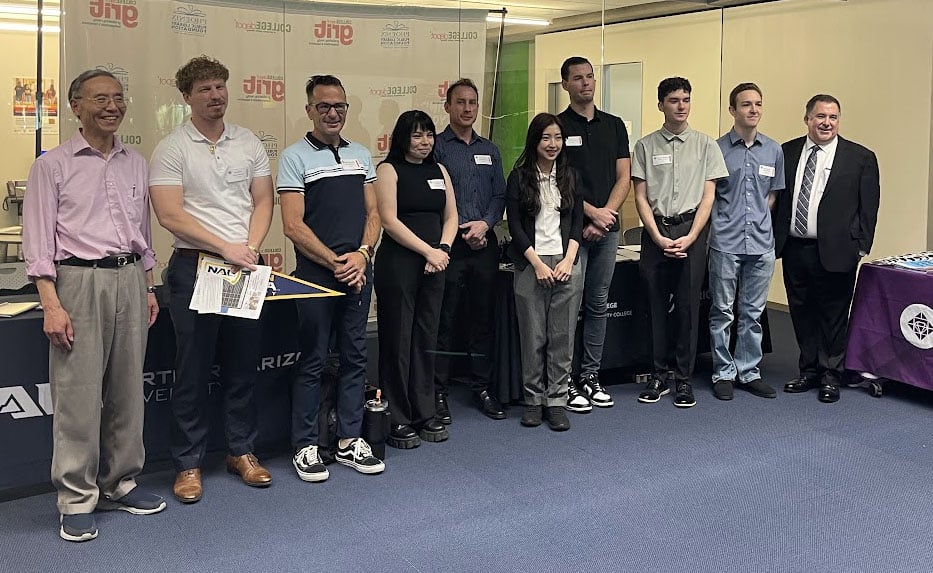


Nolan Cottingham was flipping burgers at In-N-Out when he learned about TSMC Arizona’s new technician apprenticeship program—he could work full-time in semiconductor manufacturing and earn a certificate to become a process technician.
Not only was it a good job, but it also opened the way to higher education without the price tag that had kept him out of college when he finished high school. But this program, a collaboration between Northern Arizona University, Rio Salado College and TSMC, seemed like a great fit for him.
“I’m good with computers, I’m good with thinking on the fly,” he said, “and I didn’t want to spend until I’m 40 years old paying back college debt.”
He’s now almost a year into the job, working on TSMC Arizona’s diffusion team four days a week. On Monday, he’s in class, learning about safety, data visualization, advanced manufacturing, metrology and more. He’s one of eight apprentices hired last year who started these classes in August. It’s engaging, involved work—more than food service or the high school classes that never grabbed his interest.
“How much energy you put into it is how much you can get out of it,” Cottingham said. “That’s what’s rewarding about the program. If you’re interested in a similar path, and if you can devote your time and focus, it’s absolutely worth it to go through a program like this.”
What to know about the apprenticeship
The apprenticeship program started as part of a grant from the Arizona Commerce Authority and is also supported by funding from other groups, including TSMC Arizona, Shan Strategies and the industry trade group SEMI Foundation. TSMC hires process technicians and then enrolls them in the registered apprentice program. Lauren Majure, business and educational partnerships manager in the Steve Sanghi College of Engineering, said hundreds of people showed interest in being in the first cohort.
“Most of the students don’t have a background in this group, but we found a good group of people who think in that manner,” she said. “That’s what companies are looking for now—people who are super bright and can be trained quickly.”
Students take eight classes: four from Rio Salado College, three from NAU and one safety course at TSMC Arizona. NAU professors teach advanced math, instrumentation and metrology for nanotechnology and advanced manufacturing process analysis. The metrology course includes field trips to NAU’s Microelectronics Processing and Characterization Testing (MPaCT) Center, which will hold cutting-edge semiconductor equipment and tools for research and instructional use.
It’s an important collaboration for NAU, which is increasing its presence in the semiconductor space in Arizona, Majure said, including creating a Semiconductor Training Center at the North Valley campus in Phoenix. Andy Wang, a professor in the Sanghi College of Engineering, is leading NAU’s efforts to expand educational opportunities in this industry.
The state of the industry
Process technicians play a key role in semiconductor manufacturing, which is a burgeoning industry in Arizona as more and more items need microchips to function. There’s just one small problem—there aren’t enough qualified people to fill the jobs.
This is a nationwide problem. According to the Semiconductor Industry Association, the industry will add almost 115,000 jobs by 2030, including more than 26,000 technicians and 27,000 engineers. “With a decrease in college attendance, there simply aren’t enough workers to fill the jobs that will be coming,” Majure said. “Apprenticeships like this one help to fill that gap.”
The good news, though, is the jobs are coming. According to the Bureau of Labor Statistics, jobs for semiconductor processing technicians are expected to grow 11% over the next decade, a much faster than average pace.
A day in the life of the job
There isn’t actually a “day in the life” schedule, Cottingham said; every day is different, which is one reason he enjoys the work so much. However, that made the first little while challenging. It was a little like learning in a foreign language; he’d hear acronyms and words he didn’t know and sit in “handoff” meetings unsure what was being handed off.
“I thought, ‘Will I ever be able to learn this?’ But then around the two-month mark, it became a normal thing,” he said. “It’s just interesting how much you can learn.”

Heidi Toth | NAU Communications
(928) 523-8737 | heidi.toth@nau.edu