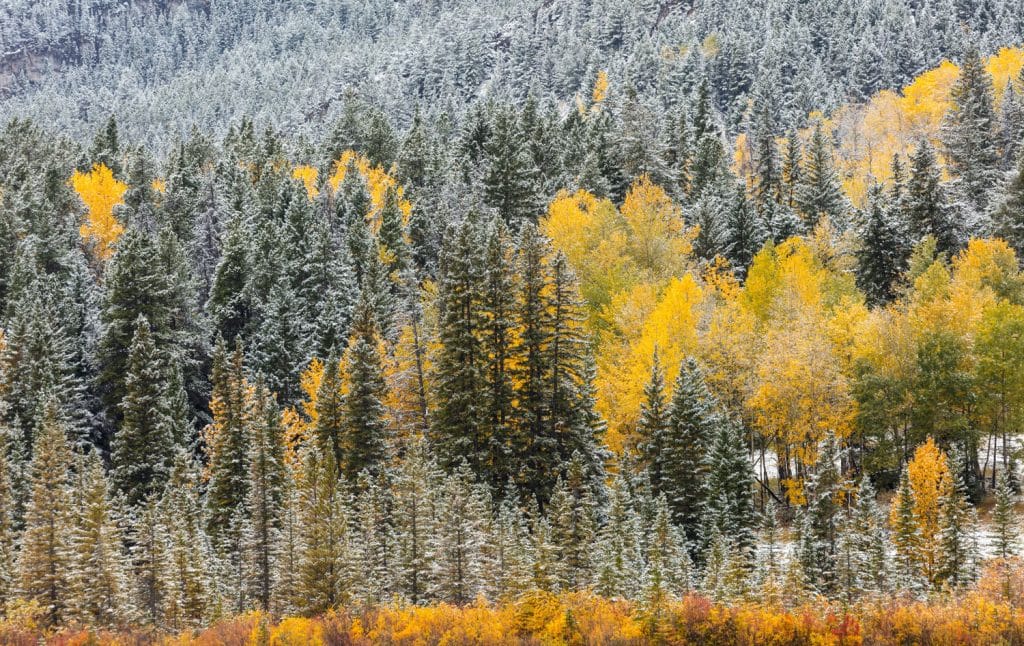


As climate change drives more frequent and severe wildfires across forests in Alaska and northwestern Canada, scientists are asking a critical question: Will these ecosystems continue to store carbon, or will they become a growing source of carbon emissions? New research published this week shows that when these northern forests shift from coniferous spruce forests to deciduous aspen and birch forests, they could release substantially less carbon when they burn.
The National Science Foundation-funded study, led by researchers from the Center for Ecosystem Science and Society (Ecoss) at NAU, found that boreal forests dominated by deciduous species lose less than half as much carbon per unit area burned compared to boreal forests dominated by black spruce trees, historically the most common species found in these cold, snowy locations. The researchers found that even under severe fire weather conditions, carbon losses in deciduous forest stands were consistently lower than those in conifer forests.
The study was published Jan. 15 in Nature Climate Change.
“This work shows that not all boreal forests burn the same way,” said Betsy Black, who led the study as part of her master’s thesis research at NAU. “As deciduous trees become more common after fire, they can fundamentally change how much carbon is lost to the atmosphere during future wildfires.”
Boreal forests store a large fraction of the world’s land-based carbon, much of it locked away in thick organic soils that have accumulated over centuries. Historically, these forests have acted as a carbon sink, absorbing much more carbon dioxide than they release. But warming temperatures have increased fire size, severity and frequency, raising concerns that boreal ecosystems could shift toward releasing more carbon than they store, accelerating climate change.
“Our previous research shows that deciduous forests can accumulate much more carbon after fire than spruce forests,” said Michelle Mack, Regents’ professor in the Department of Biological Sciences and Ecoss and senior author on the study. “But we were curious about what happens to that carbon when these forests burn. No one had measured that before.”
To answer that question, the team analyzed carbon pools and combustion losses in plots in nearly a dozen large fire scars across Alaska and Yukon. They found that deciduous forests store more carbon aboveground in combustion-resistant tree stems and less in deep organic soils that readily burn, resulting in lower overall carbon emissions during fires.
The study also revealed stark differences in what controls carbon loss between forest types. In conifer forests, emissions were driven primarily by bottom-up factors, such as fuel availability and soil moisture. In contrast, carbon losses in deciduous and mixed forests were more sensitive to fire weather conditions.
“Seeing weather play such a strong role in deciduous forests was surprising, and it suggests that as climate change drives more extreme fire weather, these forests could become more vulnerable in the future,” said Xanthe Walker, Ecoss professor and corresponding author.
Together, the findings suggest that increasing deciduous dominance, which is already widely observed following severe fires in northwestern North America, could help slow the positive feedback between wildfire and climate warming by reducing carbon emissions per unit area burned. By quantifying how much carbon is lost when deciduous forests burn and identifying the conditions that control those losses, the study provides critical data for improving wildfire and carbon cycle models and forecasting future global carbon dynamics.
Co-authors on the study include Scott Goetz and Logan Berner of the School of Informatics, Computing, and Cyber Systems at Northern Arizona University, along with Brendan Rogers, Winslow Hansen, Anna Talucci, Stefano Potter and Jacqueline Dean from the Woodwell Climate Research Center and the Cary Institute of Ecosystem Studies. This research was supported by the National Science Foundation, NASA and the Bonanza Creek Long-term Ecological Research Program.

Jill Kimball | NAU Communications
(928) 523-2282 | jill.kimball@nau.edu