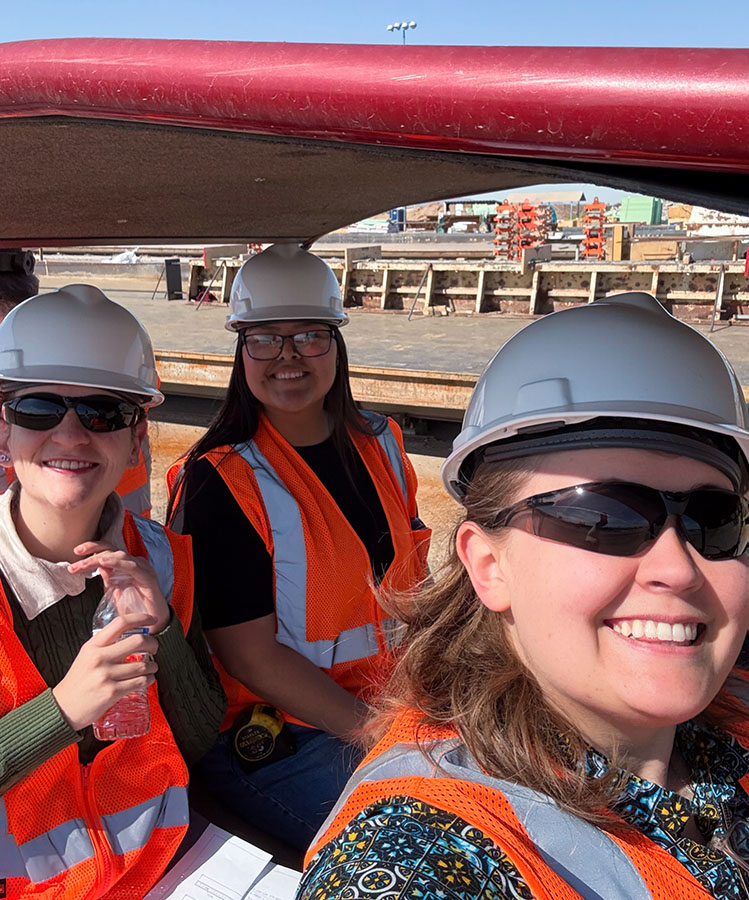


It takes a lot of work to build a beam that won’t work. It takes even more work to build one that not only will break but will do so in a way you can predict. That’s what NAU’s PCI Big Beam Competition team—Payton Correia, 2025 graduate and civil design engineer at Revamp Engineering; Isabella Velasco, 2025 graduate and assistant engineer at Dibble Engineering; Zachary Fukumoto, 2025 graduate; Caitlin Yazzie, master’s student in civil engineering; and Ben Dymond, associate professor in the Department of Civil Engineering, Construction Management, and Environmental Engineering—did: They won first place at the PCI Big Beam Competition in August for their efforts, and Correia and Velasco shared their experiences.
Tell us about the competition.
Correia: The PCI Big Beam Competition asks student teams to design and test a prestressed/precast concrete beam according to a set of parameters and ranges. While most of the time, you don’t want a design to break, we had to make sure our beam failed in specific ways, cracking between 20,000-32,000 pounds of applied load and breaking after reaching 32,000 pounds. The competition scores were weighted based on how heavy your beam was, how much midspan deflection the beam experienced at 32,000 pounds applied load, how accurate our predictions were and how much our beam “costs” according to uniform material costs. We created a formal video of our full test and a report and informal video describing our processes, design decisions and testing.
What did you do in the way of prep work?
Velasco: NAU doesn’t typically offer a prestressed concrete class, so we had weekly scheduled time with Dr. Dymond. These meetings were first in lecture form where Dr. Dymond would go over the basics of prestressed, and he gave us notes and homework from past classes that he had taught to help us. After we had a solid understanding, we started making our own calculations. This part took months to complete. Payton and I would work on our calculations for so long that I would have to sleep on her couch because it had gotten so late. We had the help of Dr. Dymond and Dr. Robin Tuchscherer when we needed any clarification.
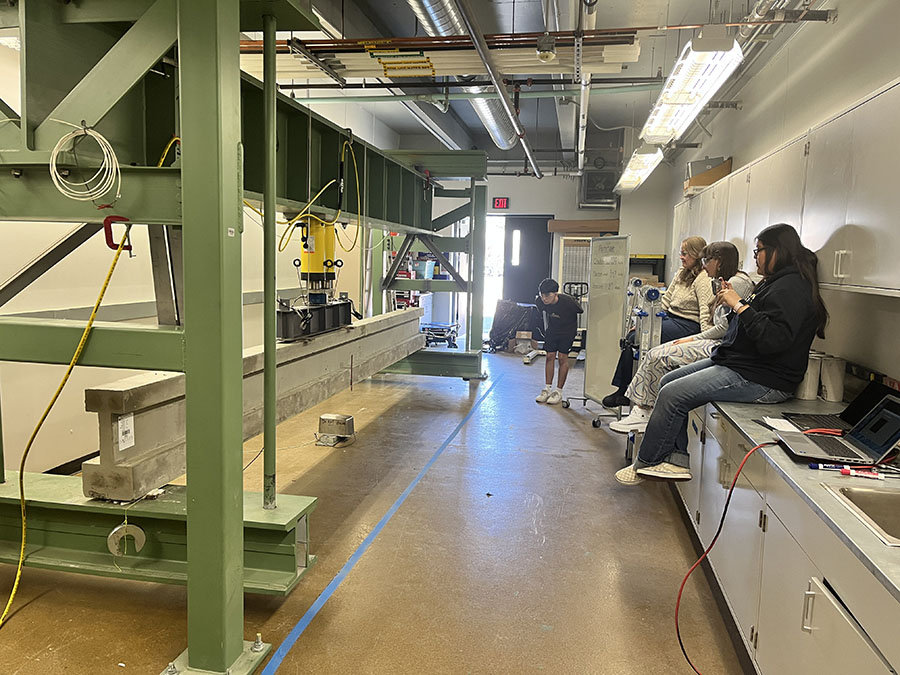 Once we got to the design of the beam things really started picking up. We had set up our calculations on a software called MathCAD, a fancier version of Excel, so we could put in our dimensions to see how the beam would behave. Through this we were able to get all the information we needed, and it was down to making the perfect beam. This part was my favorite because every time Payton or I got a beam to perform how the rules stated it was a rush. I know it sounds nerdy, but being able to have a design that works and having our calculations verifying that was so rewarding.
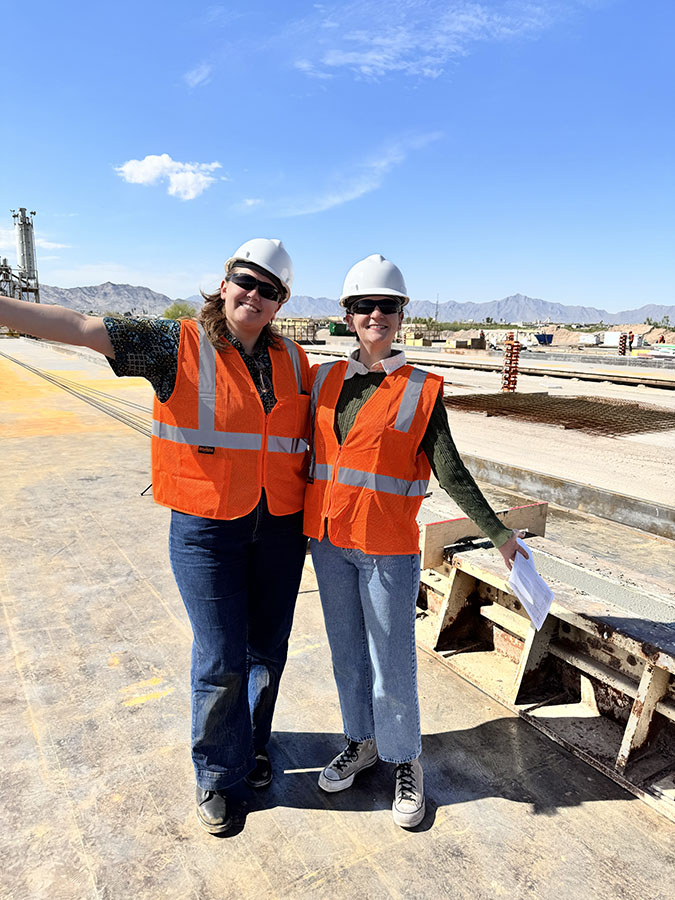
The team went down to TPAC, a prestressed precast concrete manufacturer, to see our final beam being made and it was incredible. Once the beam was at NAU I couldn’t stop smiling and forcing all my friends to go see our beam. Payton and I had named the beam Stacy. I was so nervous the day we were going to test and break Stacy because we just wanted everything to go perfectly. Everything did go perfectly. I was so proud and happy that all that hard work worked, and our predictions were so close.
Correia: It was such a relief when we got to see it in person—fully cured and unharmed from the cutting of the prestressing strands. During the naming ceremony of the Steve Sanghi College of Engineering, attendees got to explore the incredible labs here at NAU, and I asked guests to sign our beam to wish us luck during testing!
How did it feel to win?
Velasco: I about died when I saw the email and read it over again and again. I was at work, but I ran outside and called Payton to make sure it said what I thought. I had no words; I never expected us to win, which I should have based on the fact that Payton and I threw ourselves into the project. It was so incredibly gratifying to win since that year all I had thought about was this competition. It was everything to Payton and me. We would go out and look for inspiration on our beam, looking closely at bridges and seeing what shape they used and how they had the proportions.
Correia: Bella called me as soon as she found out and we just screamed on the phone. It was such a relief to know that our months of hard work had paid off, it was like finally getting a breath of fresh air. It was amazing to finally take a step back and appreciate all that we’d worked on over the previous year.