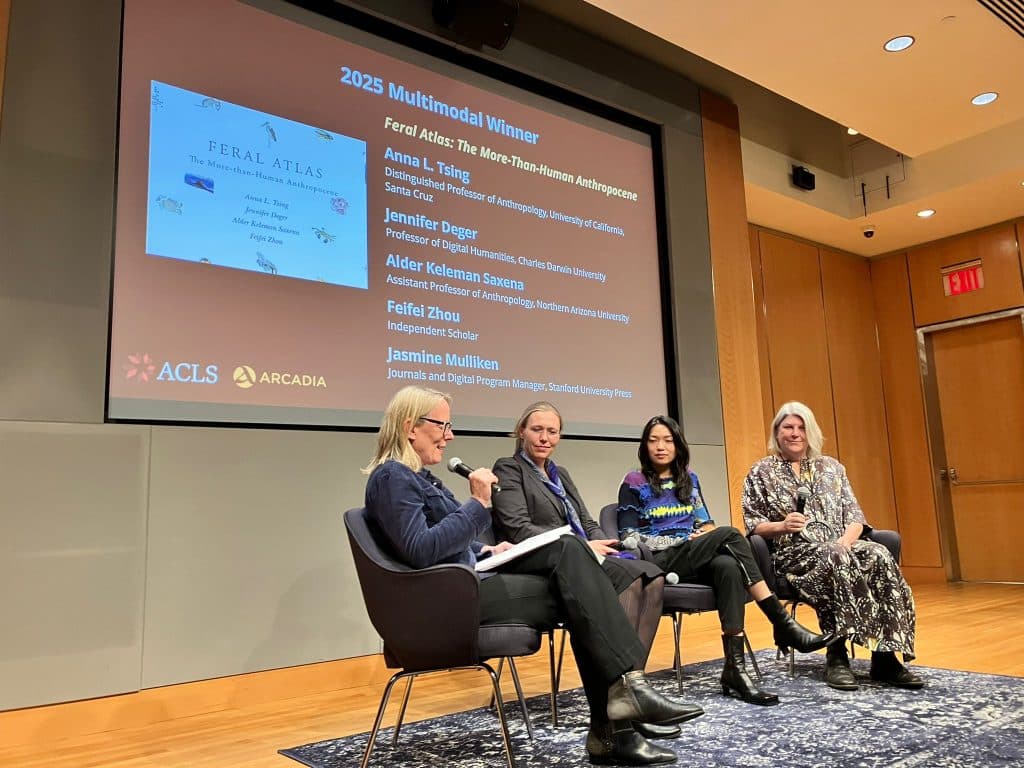


 Alder Keleman Saxena, an assistant professor at the Department of Anthropology and Program in Sustainable Communities, recently received the American Council of Learned Societies (ACLS) Arcadia Award, which supports and rewards open-access books in the humanities. Learn about the multimodal project that granted her the award.
Tell me about the ACLS/Arcadia Awards.
This prize was created by ACLS, which is one of the most prestigious foundations supporting humanities and social sciences scholarship, together with the Arcadia Foundation, a family foundation that promotes open-access knowledge, with the intent to recognize and incentivize significant efforts in open-access publishing (that is, publishing in digital formats without a paywall).
Academic knowledge has historically faced barriers to distribution, especially in the traditional book format, which limits both the group of people who have access to that knowledge and the application of new knowledge in wider spheres. Digital media have great potential to lower those barriers, but current publishing structures still tend to follow a paywalled model. Sometimes things that are published in open access are considered “less scholarly” or “less important” within university promotion and tenure communities.
What does this accomplishment mean to you?
I am part of a team of editor-curator-authors who won the prize for the digital environmental humanities project, Feral Atlas: The More-than-Human Anthropocene (Stanford University Press, 2021). This is a multimodal project, which means it includes not just text but images, video and sound recordings, as well as clickable, interactive web design. In short, it really uses digital space to challenge the traditional form of the academic book. While it was a fantastic project to create, we have found that it faces precisely the kinds of problems of legibility in academic circles that this prize was created to counteract. I have been so grateful to see the attention the project has received in the fields of art and design, as well as from the general public — and this award really adds to that by attesting to the scholarly legitimacy of our work.
What is your book about?
The project aims to shed light on all the wild, weird and concerning things that are happening to “nature” in this strange period, sometimes referred to as “the Anthropocene.” More specifically, it looks at how human-built infrastructures have interacted with non-human entities (both living and non-living) to generate new, undesigned and often uncontrollable effects, which we think of as “feral.” Thinking in this way helps us see nature not as something that we act upon with intent, but rather as a set of responsive and unpredictable entities, which are always pushing back against human actions and designs, whether we notice it or not.
Recently, as a follow-on to the digital project, we published a print book, Field Guide to the Patchy Anthropocene: The New Nature (Stanford University Press, 2024). Either can be understood as a stand-alone project, but they read well side-by-side!
Tell me a memory you will cherish about the awards ceremony
For me, the best part was getting to see my co-editors (who are spread across three continents) and having a moment of celebration with them. We finished the project right at the beginning of the COVID-19 pandemic, in mid-2020, which tanked any plans we might otherwise have made of getting together to do a fun and festive launch for the project. The chance to raise a glass in recognition of each other’s work was long overdue.