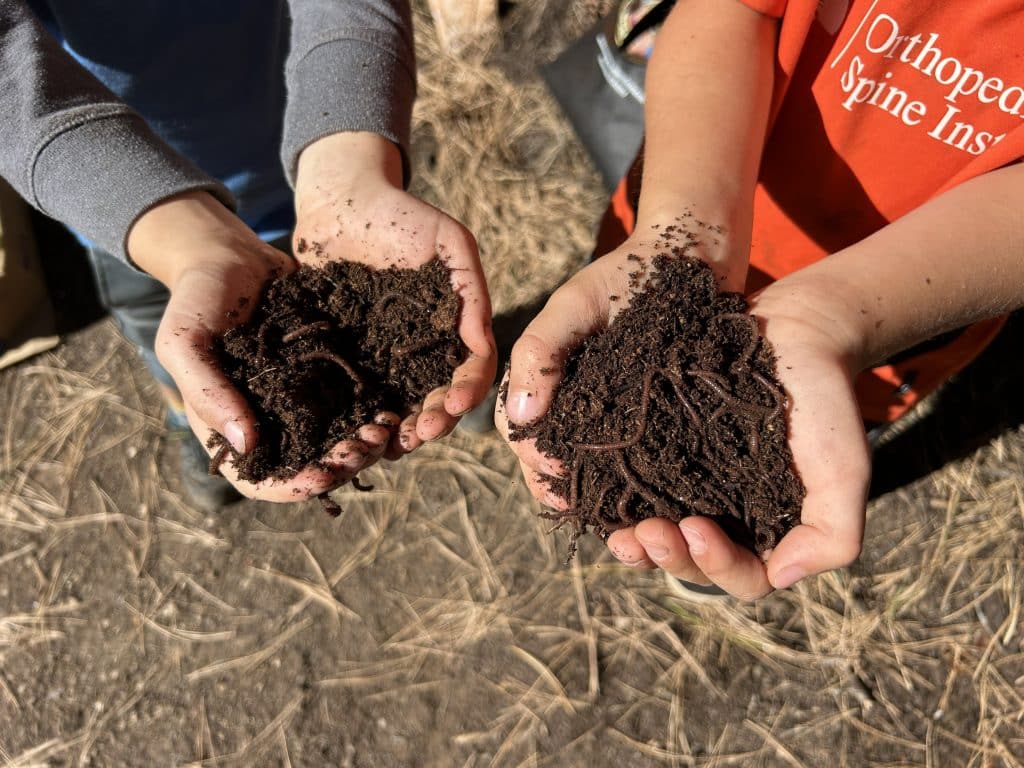


They are wriggly, quiet and hidden in the soil, but inside a dark plastic bin, these red wriggler worms are twisting through yesterday’s leftovers, turning scraps into a rich organic soil amendment.
Vermicomposting—using worms to create compost— transforms organic waste into nutrient-dense compost while reducing landfill waste, cutting greenhouse gas emissions and improving soil health. It requires little space, minimal cost and no complex technology—just organic scraps, time and a little love.
While traditional composting uses bacteria that thrive in heat to decompose materials, vermicomposting relies on worms to break down the waste at lower temperatures.
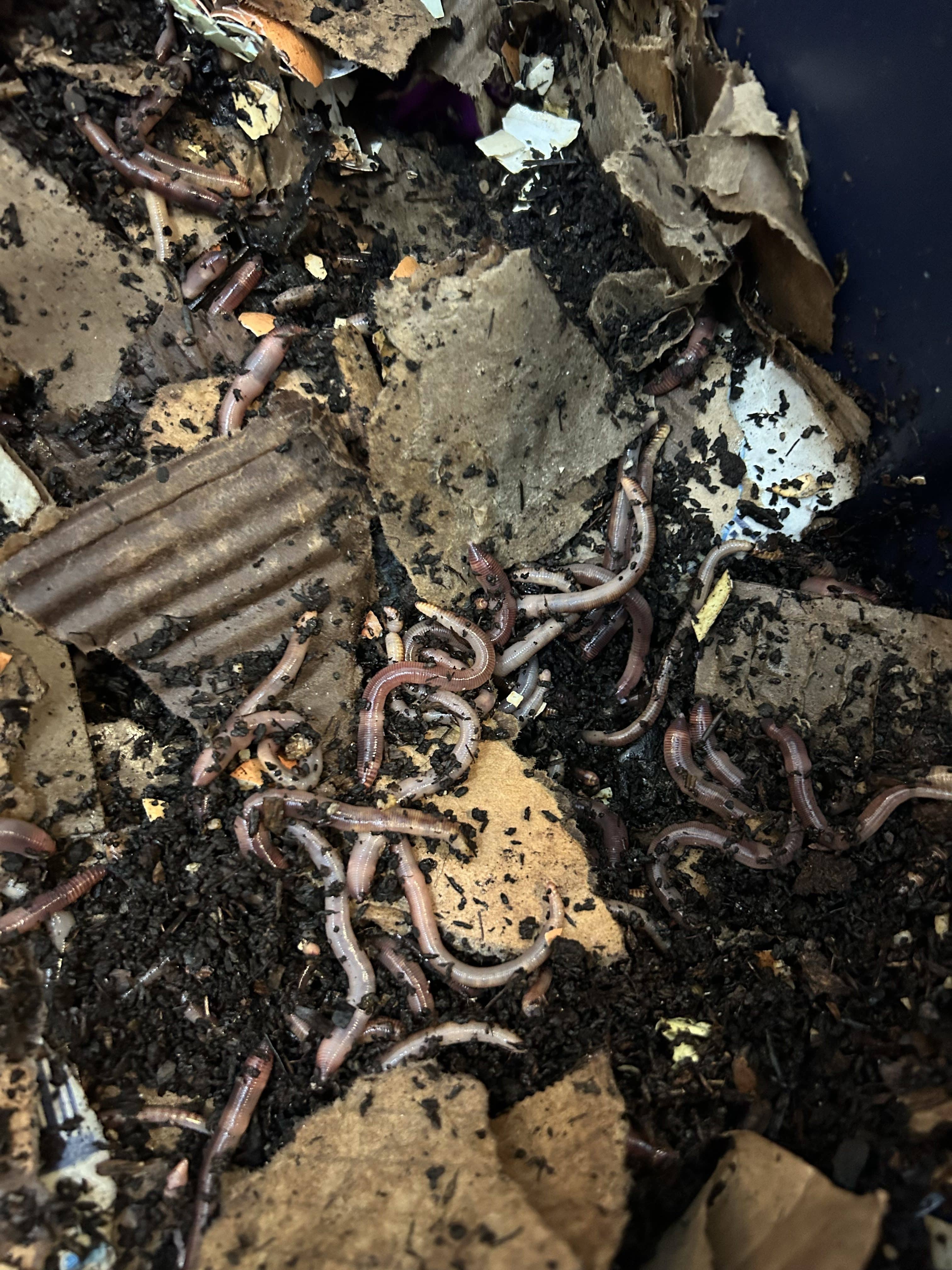 “Composting in general is the aerobic biodegradation of organic material, but it’s human-managed,” said Jeff Meilander, research scientist and program manager in the Caporaso lab at the Pathogen and Microbiome Institute (PMI) at NAU. “In vermicomposting, we essentially replace human labor with worms. By adding worms to our organic scraps, cardboard, paper, things like that, we let them do most of the work. Microbes present in the system begin breaking down the organic material, turning it into a slurry that the worms can easily ingest.”
After the worms take in that slurry material, they break it down thanks to the communities of microbes they have living in their guts. As the material passes through their digestive systems, enzymes can degrade environmental toxins, stabilize sewage sludge and eliminate pathogens. Once the material is broken down, they produce worm castings, or worm poop, which are a great organic material that contains high-end nutrients, improves soil quality and can increase crop yields.
But what microbial communities exist in worm guts? Thanks to support from NAU’s Green Fund, Meilander and his team of undergraduate students are working on not only answering that question, but on finding ways to expand this earth-friendly process across campus.
Red wigglers vs. earthworms
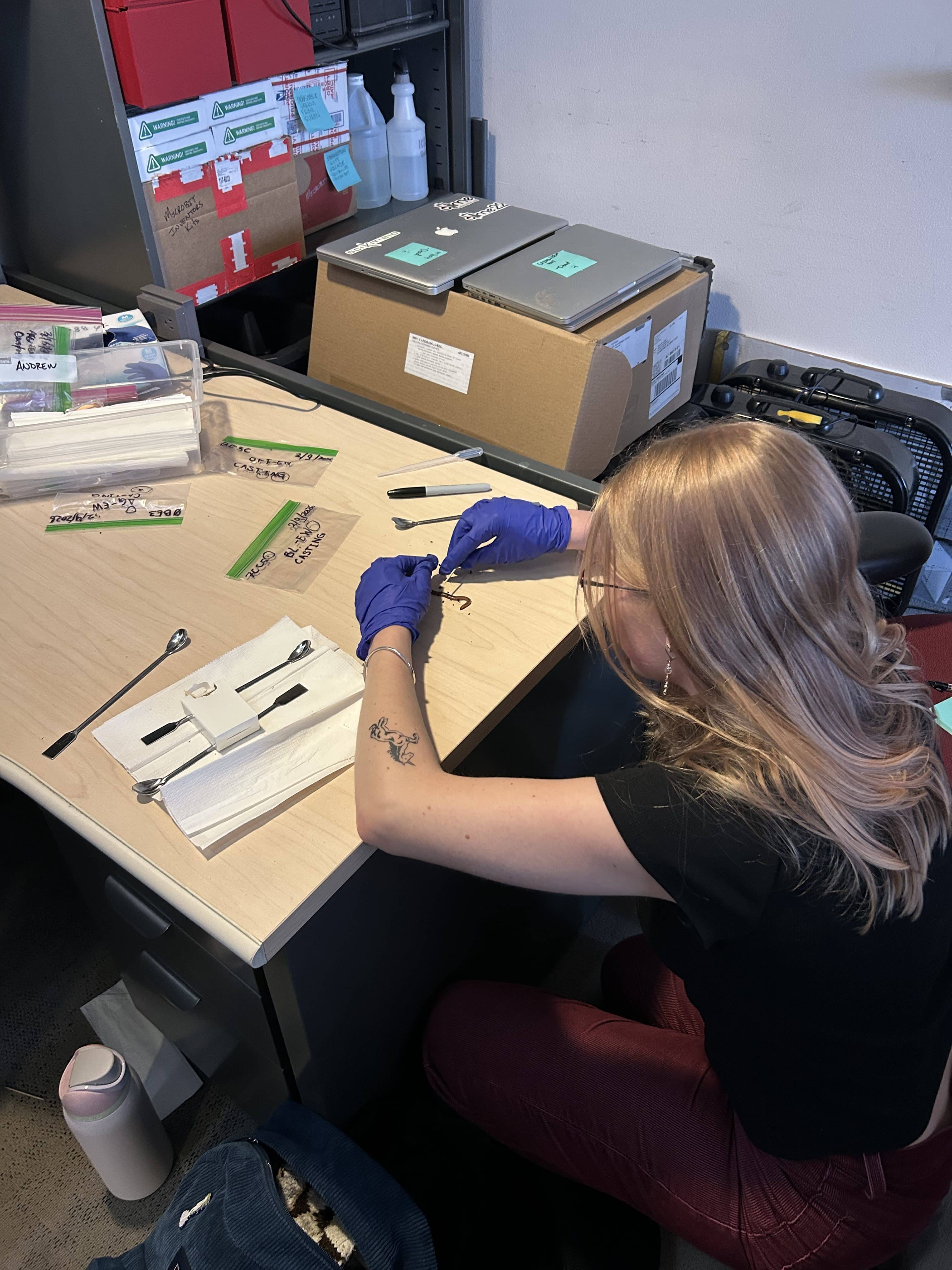 Undergraduates Brook Lercher and Andrew Gruesenmeyer are working with Meilander in researching how the diets of red wigglers and earthworms are linked in forming microbial dynamics by collecting samples of compost and worm castings and analyzing their DNA composition.
“We’ve been collecting samples of compost and worm poop,” Meilander said. “We plan to extract the DNA, then run amplicon sequencing to see what microbes are there and how they are changing over time. Which microbes are beneficial? Are they associated with certain enzymes that could accelerate the process? How exactly are they detoxifying the material? In this preliminary study, we want to see what organisms are in the worm guts but also how different diets may affect the gut microbiome across the two different species.”
Meilander said even though red wigglers are more efficient than earthworms, both offer economic benefits. The worms can be sold to farmers, used for soil remediation, incorporated into chicken feed or marketed as fishing bait, while the worm castings, which are more expensive than compost, can be applied across agricultural systems of varying scales. While they find answers, they are looking to expand their vermicomposting system across campus.
Expanding vermicomposting
Charlotte Hurley, an undergraduate vermicompost manager, helped develop a large-scale vermicomposting system supported by the Green Fund. With the help of undergraduates Ailse Soto Herrera, Flinn Scholar and Honor student Cianna Brooks as well as Lercher and Grusenmeyer, she is working on a vermicompost feasibility study to integrate systems across NAU.
“We want to build support from campus offices, departments and students on and off campus to implement small-scale vermicomposting systems, raise awareness and then scale the effort across campus,” Meilander said.
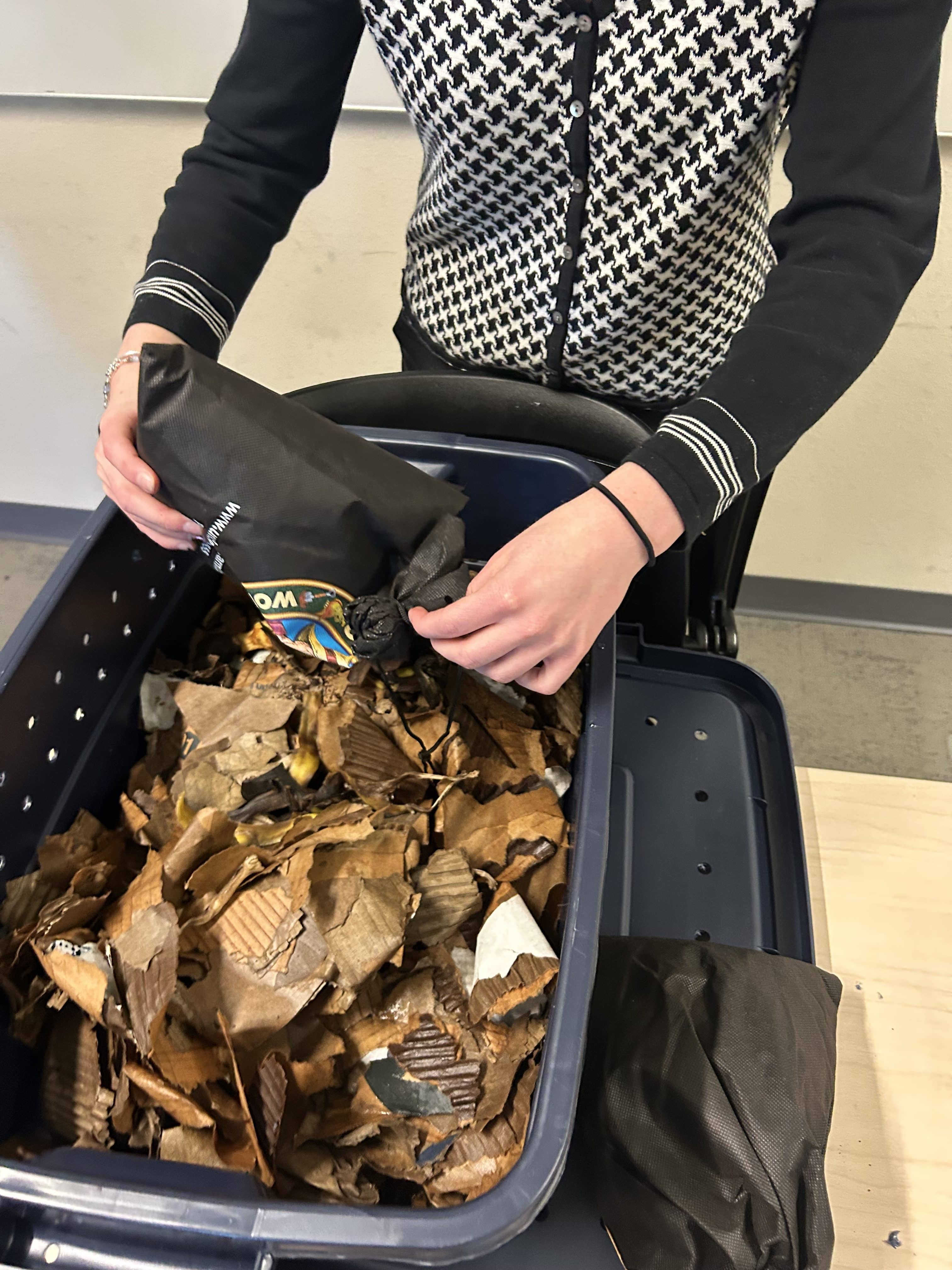 With large-scale vermicomposting, the university could use the castings in their landscaping or even sell them to the community, similar to what they do with their current composting operation. This will help reduce greenhouse gas emissions from food going into landfills and help the environment, something that aligns with NAU’s Climate Action Plan.
“I think we need alternative ways to better manage our waste,” Meilander said. “We produce a ton of organic waste that ends up in landfills that could have been composted or fed to worms. Finding more sustainable ways to manage that waste is really important. Vermicompost systems can really help with that; they are cheaper and really efficient. They don’t require much human intervention or fossil fuel-intensive technology like giant machines to turn compost. By using worms, we reduce the cost and time of manual labor which is desirable for those wanting to be more sustainable. At the same time, we’re getting this really valuable end product that can boost agricultural productivity, improve soil fertility and help address topsoil loss we’re seeing around the world.”
Meilander and his team are developing a couple of workshops to show the Lumberjack community what vermicomposting is all about. They are hosting a collaborative, hands-on vermicomposting workshop at the SSLUG garden behind the SBS West building from 2-4 p.m. April 17. They’ll have a table at Earth Jam 3-7 p.m. April 18, answering questions and showing examples of how this process works as well as highlighting other composting research they are conducting. And on Earth Day, April 22, from noon-3 p.m., they will be hosting an event to raise awareness around global sanitation at the Compost Microbiome Lab located at the Environmental Engineering Laboratory field site behind the APS substation.
For more information about vermicomposting or to discuss collaborative projects, contact Jeff Meilander at Jeffrey.Meilander@nau.edu.
 Mariana Laas | NAU Communications
(928) 523-5050 | mariana.laas@nau.edu