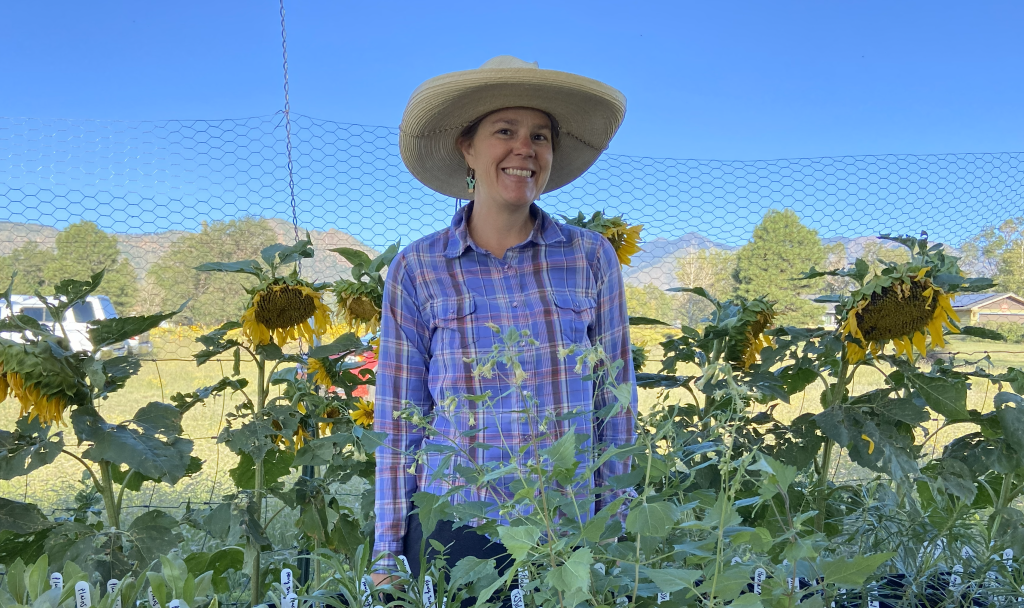


Across rural landscapes, agriculture is often portrayed as a way of life rooted in resilience, independence and endurance. Yet behind this narrative, there is an unspoken reality: the growing mental health pressure faced by those who work on the land. For women in agriculture, this strain is compounded by unique social, economic and cultural pressures. Balancing physically demanding labor with caregiving roles, financial uncertainty, isolation and the expectation to remain dependable in the face of adversity has created a silent mental health crisis among women in farming communities.
Gayle Gratop, a doctoral student in the Interdisciplinary Health Program at Northern Arizona University and an assistant agent at the University of Arizona Cooperative Extension, is searching for ways to offer support for women in agriculture where traditional systems fall short.
“Farm stress is impacting farmers and ranchers across the world, resulting in the fourth highest suicide rate in the United States by occupation,” Gratop said. “My dissertation research is focused on how farm stress is impacting women farmers and ranchers across Arizona and identifying what resources they need to support their mental health.”
According to the Centers for Disease Control and Prevention, most farmers who die by suicide are men. However, Gratop said research shows that women farmers and ranchers are more prone to anxiety and depression.
“My background is in horticulture, and one of my major programmatic areas at the Cooperative Extension is developing a statewide farmer mental health program,” Gratop said. “Arizona is tied with Alaska as the highest percentage of female agriculture producers in the country. We work closely with the Arizona Department of Agriculture and the Arizona Farm Bureau, trying to get the word out there to farmers that they are not alone. A lot of times, they are isolated due to the nature of their work, and the first step is to reduce the stigmas they might have around mental health.”
With help from a Western Sustainable Agriculture Research and Education (SARE) grant, Gratop, who is also a local grower, will conduct community-based participatory research focused on female agricultural producers throughout the state. She developed the research questions collaboratively with a team of female farmers, ranchers and agents at the Cooperative Extension who have first-hand experience with the struggles they face every day. This team will be involved in every stage of the research process.
“What research is out there about women shows they often experience what is called a triple burden,” Gratop said. “In addition to farming, they are doing a lot of off-farm work to get insurance for their families while also taking care of all their domestic and household duties. I conducted a pilot study last April in Yavapai and Coconino counties among female producers, and their top stressors align with what’s in the literature.”
Alder Keleman Saxena, assistant professor at the Department of Anthropology and principal investigator for this grant at NAU, said this research addresses an important but under-acknowledged topic for Arizona.
“Farming is a stressful enterprise even under the best of circumstances,” Keleman Saxena said. “Farmers have to think about so many things that are not obvious to the rest of us in the food system: when and how they will get water for planting, where they will get seed or plant starts and how much they will cost, where and how to sell their crops to get the best price, and whether or not to invest in infrastructure that could make their lives easier, but then again, might not pay off if all the other conditions don’t align.”
Aside from all these common stressors, women also encounter structural barriers, land access barriers and other gender disparities. Farming is physically intense work, and women often suffer from chronic pain from the need to prove themselves in this male-dominated profession. To recognize women’s vital role in the food system despite all these barriers, the United Nations designated 2026 as the International Year of the Woman Farmer.
“One really important thing about the model we are using is that we are actually involving women farmers as part of the research team,” Gratop said. “We are going to create outreach materials that are based on their needs. This grant has a huge educational component, and the team has identified conferences where women in agriculture are gathering, like the Arizona Farm Bureau’s Women’s Leadership Conference, the Arizona Cowbells and the Summit for Indigenous Women in Agriculture that happens every year. We are going to design outreach materials to speak to each of those audiences and we are going to present them during the conferences.”
Another component Gratop believes will help address mental wellness among women growers is education on how to cope with stress. During the pilot study, the group not only identified mental health vouchers and health insurance as tools that could help them manage stress, but also said that classes about agribusiness management, occupational health and wellness would be beneficial.
“No matter what scale of farming you are looking at—from a backyard garden to a high-acreage irrigated farm—food doesn’t produce itself without human involvement, so figuring out ways to ease these stressors and keep people in farming is really important for fostering food system resilience in this region,” Keleman Saxena said. “Gayle’s research should generate not just new knowledge in this regard, but actionable solutions, which might also be applicable to other places.”
 Mariana Laas | NAU Communications
(928) 523-5050 | mariana.laas@nau.edu