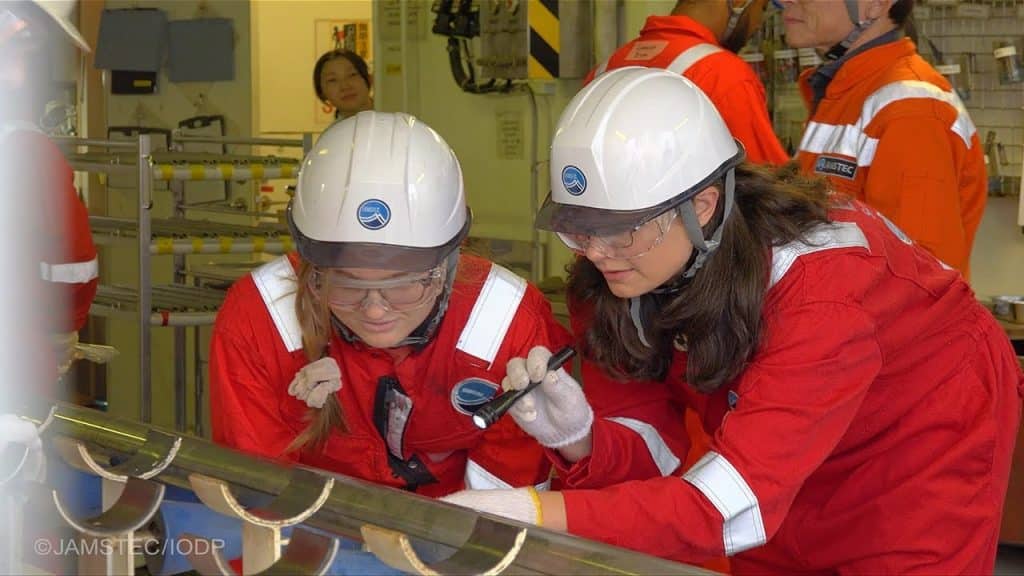


How do the most intense earthquakes and tsunamis happen, and what can we do to mitigate the harm they cause? Thanks to geologists like Christine Regalla, an associate professor in the School of Earth and Sustainability, we’re closer to answering big questions like these. Regalla recently won the International Ocean Discovery Program’s prestigious Taira Prize for her work in the Pacific Ocean and in the lab, where she employs land-based research methods to understand what’s really happening when tectonic plates move. The IODP prize is given each year to an early- to mid-career researcher who has made significant, trans-disciplinary contributions using data obtained through scientific ocean drilling. We asked her a few quick Qs about her research and the award.
Tell us about the research that earned you this prize.
A cornerstone of my research is using ocean drilling data to understand the geologic evolution of subduction zones, or plate tectonic boundaries, and their implications for hazards like large earthquakes and tsunamis. By integrating drilling data with other marine geophysical datasets like seismic imaging of geological structures below the seafloor, I have measured the style and rate of deformation where the tectonic plates meet off the shore of Japan. This subduction zone has experienced large and damaging earthquakes, including the 2011 magnitude 9.1 earthquake. One unique aspect of my research is applying land-based research techniques to marine settings. For example, I have adapted techniques to measure the amounts of the element beryllium-10, which is usually measured on land, to determine the age and movement of deep-sea sediments. I have also taken methods of analyzing topography to understand faulting on land and used them to understand faulting below the seafloor using bathymetric maps, which measure ocean depth. Through the years, my work has been made possible by the data and collaborations I built while participating in IODP scientific ocean drilling expeditions.
What does it mean to you to be recognized by your peers in this way?
It is an incredible honor to be selected for the 2025 Asahiko Taira International Scientific Ocean Drilling Research Prize. The opportunities to participate in multiple ocean drilling expeditions—from sailing as a graduate student on Expedition 343 following the 2011 Tohoku-oki earthquake to serving as co-chief scientist on IODP Expedition 405—have been among the most rewarding and transformative experiences of my career. These experiences have shown me the strength of international scientific collaboration and the extraordinary creativity and innovation that emerge when scientists from around the world work together to solve complex problems. I am deeply grateful to the scientists, engineers, technicians and staff whose expertise, dedication and collaboration make ocean drilling science possible and continue to expand our understanding of the oceanic frontier.
Where is your research headed next?
We are just at the beginning of being able to solve some of the most challenging scientific questions regarding what causes large earthquakes and tsunamis. The data we have collected from northeast Japan after the 2011 Tohoku-oki earthquake and tsunami are allowing us to advance our understanding far beyond where we were five or 10 years ago. I’m excited to continue to work with these data and take the lessons learned to other margins of the work to assess their hazard potential.
Jill Kimball | NAU Communications
(928) 523-2282 | jill.kimball@nau.edu